For years, it seems that the Serbian Government has operated under the assumption that being almost aligned with EU criteria should be treated as meaningful progress. This mindset has contributed not only to the slow pace of reforms but also to the reality that, after eleven years of accession negotiations, Serbia has opened only two clusters. Under the EU Growth Plan, however, the habit of presenting partial fulfilment as genuine reform is becoming a structural obstacle, especially in the Reform Agenda’s area where reforms matter the most: Rule of Law and Fundamental Rights.
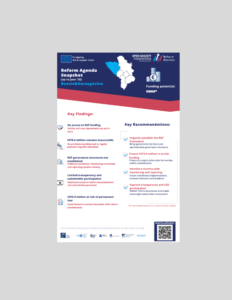
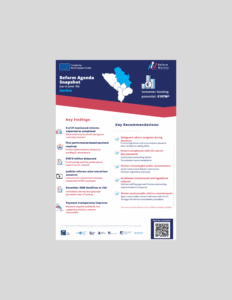
A striking example is the reform of the Unified Voter Register. The entire process – including the audit – was supposed to be completed by December 2024. Instead, Serbia approaches the end of 2025 with the reform still only halfway implemented. The legal framework exists, and the composition of the audit commission is progressing, but the core element, the audit itself, has not even begun. The Reform Agenda indeed provides a two-year grace period, meaning Serbia can still receive the funds associated with this step. Yet the fact that a reform so central to electoral integrity and democratic legitimacy has not been prioritised for an entire year raises a deeper concern: if even this cannot be delivered on time, what does that say about the seriousness of the overall reform effort?
A similar pattern is visible in the area of anti-corruption. Serbia adopted a new Anti-Corruption Strategy in July 2024 and, at first glance, appeared to fulfil its obligation by adopting the accompanying Action Plan in December of the same year. However, the Action Plan covers only 2024 and 2025, rather than the entire duration of the Strategy, despite the Reform Agenda explicitly requiring a full implementation cycle. The result is a reform that is presented by the Government as “completed,” but it is substantively partial. It illustrates how institutional energy is often invested in satisfying the appearance of compliance rather than in establishing the foundations of effective policy.
The case of the REM Council further reinforces this pattern. In addition to being a formal obligation under the Reform Agenda, Serbia also committed in December 2024 – through a non-paper submitted to Member States – to urgently complete the election of the Council as part of a broader effort to persuade Member States to support the opening of Cluster 3. A year later, eight of the nine
members have been elected, leaving the Council still incomplete. The process has been repeatedly interrupted, criticised by civil society, and burdened by procedural controversies. It is an improvement, but it is also plainly insufficient. In the logic of the Growth Plan, partial reform is simply not reform at all.
The only exception within this framework applies to quantitative steps – those formulated as reaching a specific number or percentage – which may be assessed as partially fulfilled and can therefore trigger partial disbursement, proportional to the share of the quantitative target that has been achieved. But qualitative reforms – and most rule-of-law obligations fall squarely into this category – cannot be treated this way. They must be implemented fully, not approximately or substantially. This is not a procedural detail; it is the core principle that separates reforms that exist on paper from reforms that genuinely reshape institutions.
This accumulation of “almost reforms” now appears to be complicating the European Commission’s assessment process. Serbia submitted its first and second payment requests in March and July 2025, yet no decision has been issued, well beyond the usual timeframe. Part of the delay likely reflects the Commission’s attempt to distinguish what is genuinely fulfilled from what is merely presented as such, requiring follow-up questions and clarifications from the Government. But the unusually long period may also indicate a deeper review – one that goes beyond individual reform steps and examines whether Serbia continues to meet the fundamental preconditions related to democratic institutions, rule of law, and the normalisation of relations with Pristina.
At this moment, Serbia faces a choice. Treating EU reforms as a checklist has produced diminishing returns. What is needed now is not more drafting, nor more announcements, but clear political will and institutional capacity to deliver reforms in full. Partial implementation cannot restore trust, cannot unlock credibility, and cannot bring Serbia closer to the European Union. Only genuine, complete reforms can do that.
Almost done is not done. And almost-membership is still not membership. If Serbia is serious about its European future, it must demonstrate that seriousness through reforms that are implemented fully, not symbolically, and through institutions that function in practice, not only on paper.
Author: Marko Todorović, European Policy Centre (CEP)
Image created with Gemini