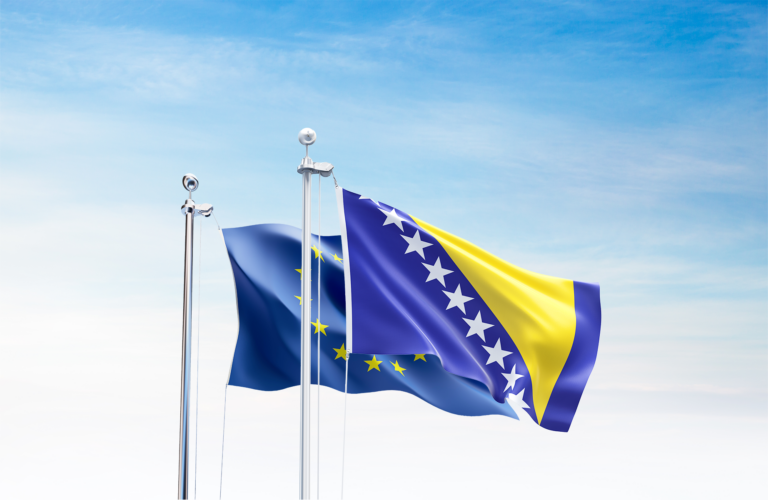
The Growth Plan for the Western Balkans (WB) was adopted by the Commission on 8 November 2023. The Growth plan was formed with the idea of fostering an increase in socioeconomic convergence of WB states. The Plan is based on four pillars aimed at:
- Enhancing economic integration with the European Union’s single market
- Boosting economic integration within the WBs through the Common Regional Market
- Accelerating fundamental reforms
- Supporting convergence through increased financial assistance
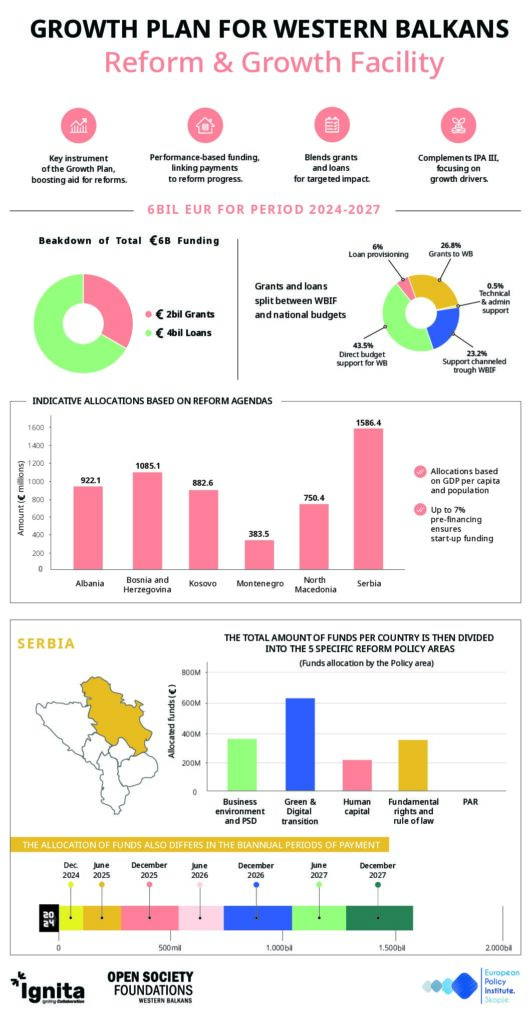
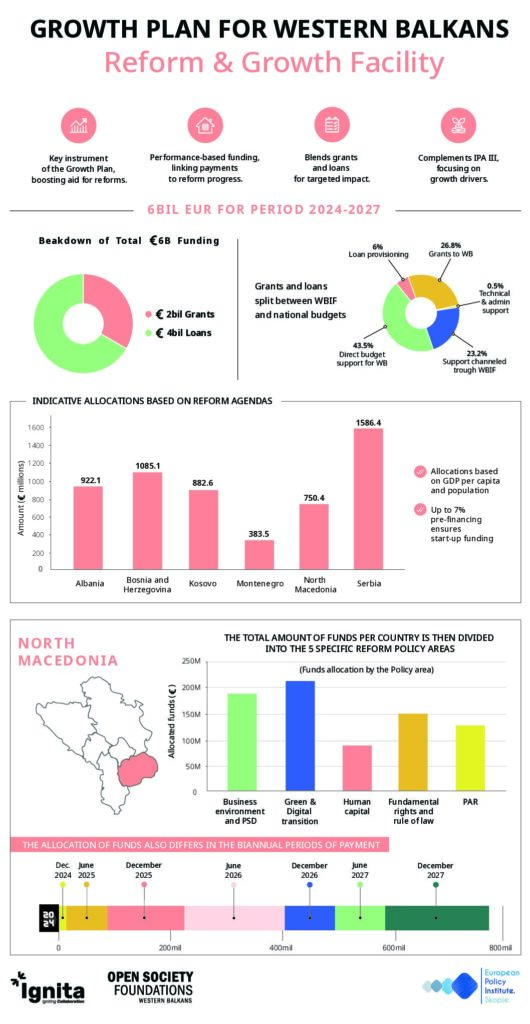
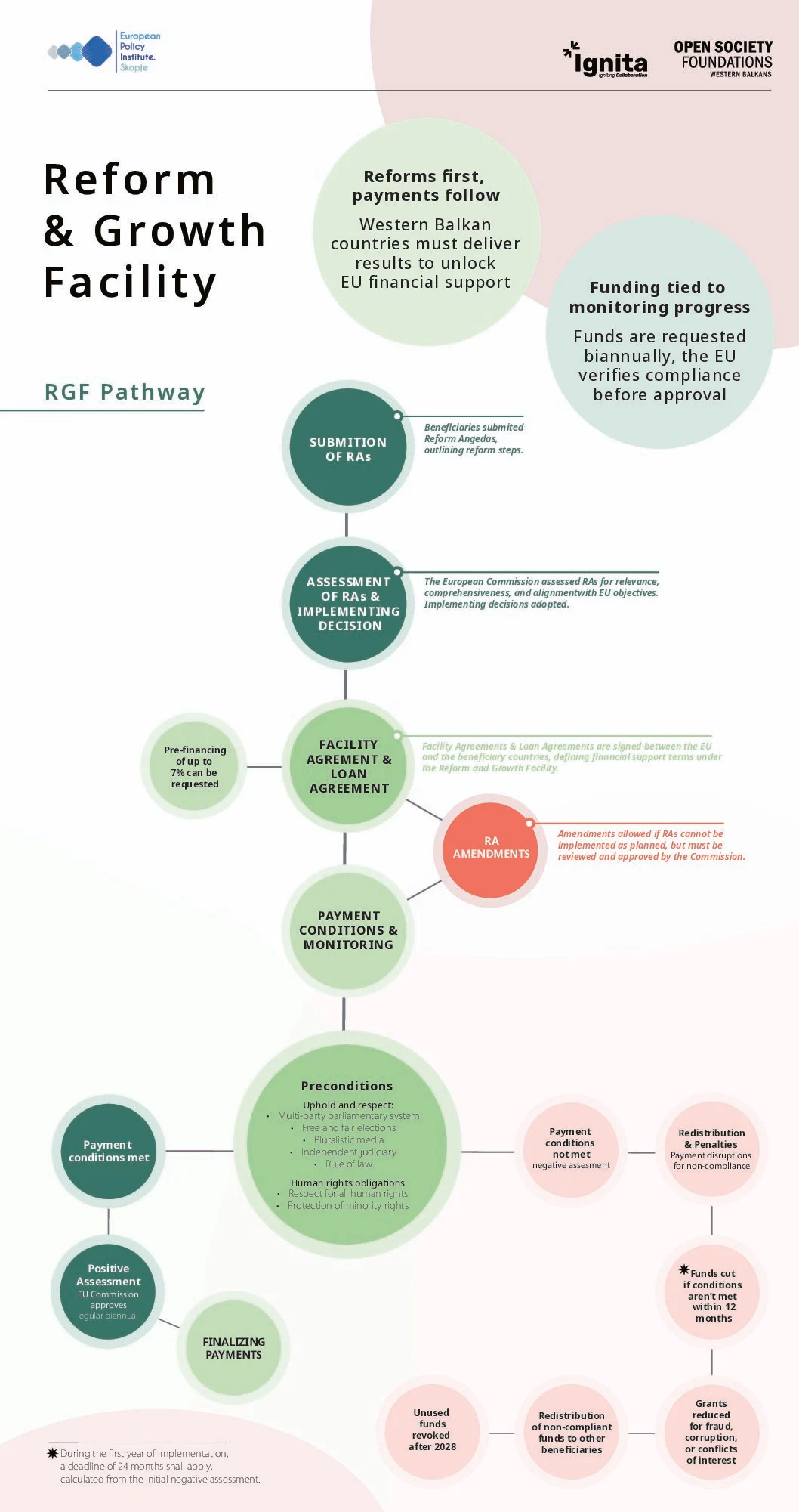
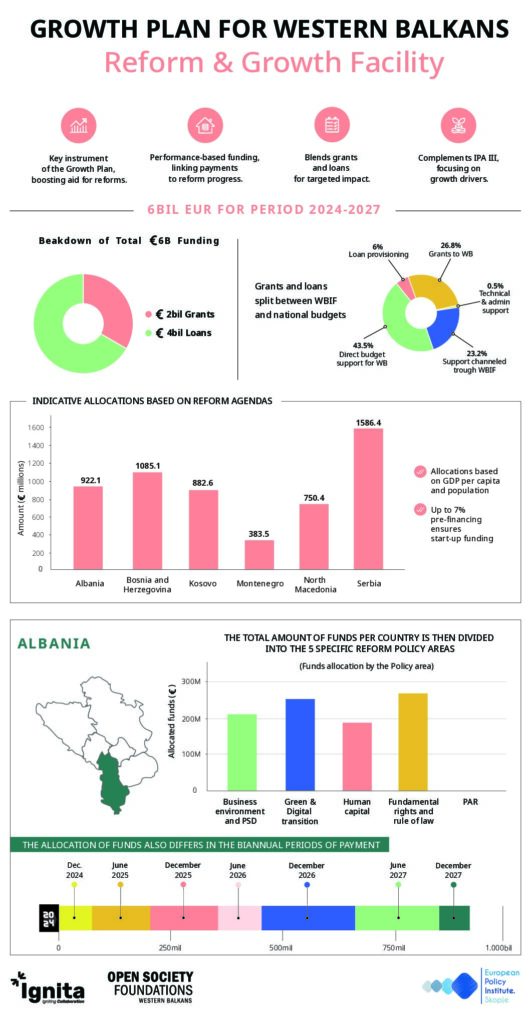
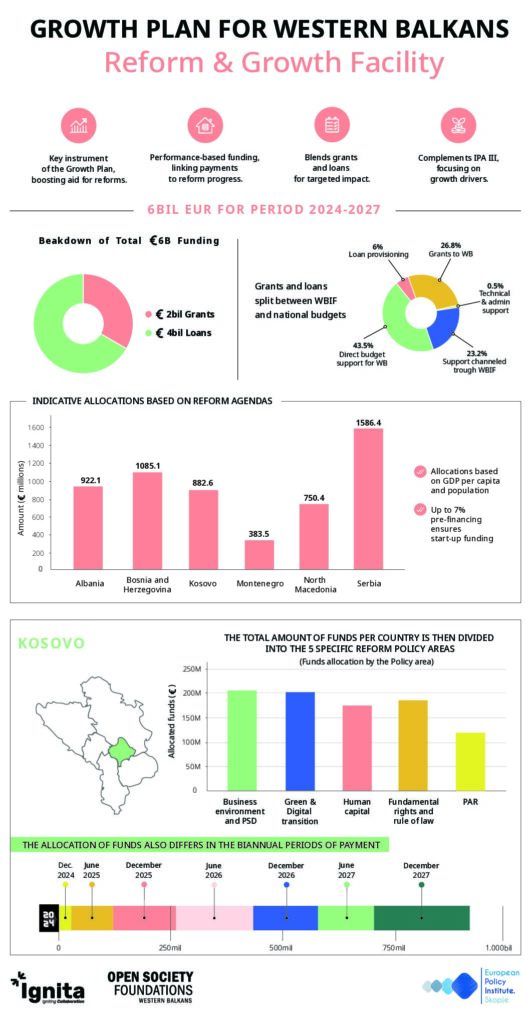
The Facility has a total financial envelope of €6 billion for 2024-2027, consisting of €2 billion in grants and €4 billion in concessional loans, with payment conditioned on the WB partners implementing specific socio-economic and fundamental reforms.
Each country is receiving a different amount of financial support, and for Bosnia and Herzegovina (BiH) this amount is 1,085 billion€. The Growth Plan for the WBs is an opportunity for BiH to receive funds after fulfilling concrete reforms that should create conditions for stronger economic growth, including more functional institutions, a stronger rule of law and a better business climate. In addition to investments and reforms, the Growth Plan opens opportunities for BiH to have greater access to the European single market, as well as to establish a common regional market in the WB.
Process of development and adoption of the Reform Agenda in the national context: Challenges on the way
To access the funds, BiH should create and submit to the European Commission a reform agenda. The key two steps are to agree on a list of indicative reforms and steps in the reform process and to prepare the narrative of the Reform Agenda. The working team was created in January 2024, composed of the Chairwoman of the Council of Ministers of BIH, Prime Ministers of both entities, State Ministers of Foreign Trade and Economic Relations, Communication and Transport, Finance and Treasury, the Ministry of Justice, as well as Entity Finance Ministers. The members of the working team are the prime ministers of all 10 cantons in the Federation of BiH, the mayor of Brčko District and the directors of the BiH Directorate for Economic Planning and the Directorate for European Integration.
Representatives of the parliaments in BiH didn’t actively participate in the process of creating the reform agenda. As stated in the previous paragraph, the members of the Working Team for the Reform Agenda were the presidents of the entity governments as well as the ministries of the entity governments. During the design process of the reform agenda, public consultations were not organised, moreover, the content of the reform agenda was never publicly presented. As in many cases so far, including this process, the design of creating a strategic document was presented to the public as an important step forward in the process of progress towards European integration, and it was represented in the media, but public opinion was unable to perceive the positive or negative aspects of the process itself or the content of the document.
After the formation of the Working Team, the process of creating a reform agenda began in accordance with the working version of the document, Reform Plan for BiH, which was previously sent to the European Commission, as a basis for creating an indicative list of projects and priorities. It is a document that contains four priorities, namely: Green and digital transition, Development of the private sector and business environment, Development and retention of human capital and Rule of law. But already at the very beginning, the Working Team faced problems. The second session of the Working Team for drafting the Reform Plan wasn’t held due to the lack of quorum, as representatives from Republika Srpska did not respond to the session.
Deputy Chairman of the Council of Ministers, Staša Košarac, and at the same time a member of the Working Team, requested the postponement of the session a day earlier. Zoran Zeljko, the Coordinator of the Working Team, Director of the Directorate for Economic Planning of BiH, pointed out that ”the deadlines stated on several occasions by the Delegation of the EU and the European Commission leave no room for delay, especially at this stage of the process, that the European Commission needs our position on indicative reforms so that we can continue the consultative process regarding reforms that are possibly unacceptable or unclear”.
The chairwoman of the Council of Ministers, Borjana Krišto, emphasised that BiH doesn’t have time to delay the process of bringing reforms and is necessary to continue the consultative process on reforms that are possibly unacceptable or unclear. As a country, without a statement on the reforms, we can’t even proceed with the preparation of the Reform plan for those that are indisputable, especially if we consider that the deadline for BiH’s response to the proposal for indicative reforms was January 22, 2024.
As a follow-up, the Working Team decided to make a list of reforms from the indicative list that all members of the Working Team in BiH have marked as acceptable, which will be forwarded to the European Commission with the request to continue with further activities for those reforms. The conclusion of the third session of the Working Team for drafting the reform plan is the decision to inform the European Commission about the reforms for which no agreement was reached, and in connection with this to urgently organize thematic meetings where the representatives of the institutions that didn’t give their agreement will receive additional clarifications from the representatives of the European Commission and pointed out their individual positions.
The deadline for submitting the list of reforms as part of the reform agenda was April 30, 2024. At that moment, BiH was the only one of the six countries of the WB that didn’t finalise the key prerequisite, which is submission to the list of reforms. At the very last moment, the last day before the deadline for submission to the list of reforms, the document was still not created in its entirety by the representatives of the authorities in BiH. Namely, on the last day of the deadline for submitting the list of reforms, there were no answers from the institutions of Republika Srpska. The responsible ministers from this entity didn’t declare themselves on this issue.
The working team still managed to complete the reform agenda and BiH submitted this document to the European Commission. The list of reforms approved by the Work Team was also fully harmonised with recommendations by the European Commission, meaning more than 97% reform activities agreed between representatives of the European Commission and BIH Directorate for European Integrations.
However, the document had numerous comments and corrections and was returned to B&H authorities by the European Commission for further coordination. At the end of July, the content of the document was updated again. Pressure from the public increased, demanding greater involvement in the creation of the document. However, now the cantonal ministers are involved in these negotiations, without whose consent the document will not go to Bussels, although this was not the case when the document was delivered on April 30.
A new document on the reform agenda was sent in September. The Chairperson of the Council of Ministers, Borjana Krišto, sent the draft of the Reform Agenda without the two incompatible measures. The document was sent without the consent of the lower levels of government, which showed that seeking the canton’s consent was an unnecessary move in the context of the Growth Plan. It is important to emphasise that in the process of creating the document, there were no public consultations where non-state actors would have had the opportunity to comment on the content. Moreover, the content of the document has never been disclosed in its entirety.
The document did not meet the criteria of the European Commission, ”Unfortunately, BiH hasn’t submitted a final reform agenda, and we continue to encourage the country to do so as soon as possible”, said Gert Jan Kopman, Director General of the Directorate for Enlargement in the European Commission, during his visit to BiH, in November 2024.
Contested or Blocking reforms: The Constitutional court and Council for state aid
The process of developing the reform agenda in BiH is defined as an important step forward for BiH in the process of joining European integration, but with different visions when it comes to the aspirations of the representatives of the two entities in BiH. Namely, during the process of creating the reform agenda, the representatives of the RS didn’t deviate from the process of decentralisation, or did they want to establish a complete system that would bring the reform agenda to a functional level on the territory of the entire country. On the other hand, representatives of Federation of BiH see the reform agenda as a progressive means of action in terms of financial resources that would be provided by the fulfilment of all reforms from the Growth plan. The high level of decentralisation is a problem in the functioning of BiH. The fundamental problem of BiH is the constitutional order that is being abused by representatives of all the leading political parties. This level of decentralisation simply doesn’t enable functionality. Furthermore, all three levels of government in BiH must unanimously adopt the content of the reform agenda.
The prime ministers of four cantons in the Federation of BiH (Tuzla Canton, Zenica-Doboj Canton, Central-Bosnia Canton, Una-Sana Canton) sent their consent with certain conditions, which the Council of Ministers didn’t accept. As there was no consensus, the Reform Agenda wasn’t sent to Brussels.
This document, which received the support of all actors and levels of government except these four cantons, had 111 harmonised measures out of a total of 113 measures. This time, again, the measures that the authorities in the Republika Srpska consider controversial, which refer to the filling of the Constitutional Court of BiH and compliance with the decisions of this body, and the removal of the entity veto from the Council for State Aid, were left out of the document.
The leaders of the party of the Alliance of Independent Social Democrats, the leading party in the Republika Srpska, do not want to lose the right to vote by entity when it comes to the decisions of the Constitutional Court. They don’t want the decisions of the Constitutional Court to be implemented on the entire territory of BiH. Also, representatives of the leading parties from the Republika Srpska entity do not give up the possibility that the entity authorities can put veto on the decisions of the BiH State Aid Council.
The second attempt officially failed, BiH was left without the possibility to receive 70 million€, precisely, the pre-financing tranche of the Plan, and mutual accusations began among the politicians in BiH. The leaders of the SDA Party, from which the prime ministers of the cantons who didn’t agree to this document came, criticized leaders of Our Party, People and Justice and Social Democratic Party for “accepting a plan that is not complete”, while the answer from other side was that “the four prime ministers blocked the entire country.”
Earlier, the Minister of Foreign Trade and Economic Relations, Staša Košarac, announced via social networks fact that the European proposal is not aligned with the Dayton Agreement is controversial for the Republic of Srpska. “Certain issues, which are within the constitutional jurisdiction of the RS and the FBiH, cannot be transferred to a common level under the guise of ambition towards the EU, such as the law on gas at the BiH level or the abolition of entity voting, because these are things that the RS will never agree to”, said Košarac.
The Prime Ministers of four cantons who expressed disagreement in terms of the content of the reform agenda, point out that “the document is too important to be taken lightly.”, The process of harmonising the document was conducted in a non-transparent, biased and methodologically extremely questionable manner”. Furthermore, they emphasize that reform agenda represents “the covert erasure of the state institutions of Bosnia and Herzegovina under the guise of reforms’’ and special observation is related ‘’on deleted obligation to appoint constitutional judges and the obligation to apply the decisions of the Constitutional Court of BiH on the territory of the whole country.’’
The ruling party in the Republika Srpska, the Alliance of Independent Social Democrats, is characterised as the main culprit for the unsuccessful process of adopting the document due to the non-acceptance of two measures in the reform agenda. On the other hand, the prime ministers of the four cantons were marked as the brakemen of the process because they did not want an incomplete document to be sent to Brussels that would deny the stability and integrity of BiH.
Gert Jan Kop, the Director-General of the Neighbourhood and Enlargement Negotiations, visited BiH in the middle of November and organised a meeting with several decision makers who hold the key to the adoption of the Reform Agenda document. He set a new deadline of December 4 for the adoption of the Reform Agenda. Koopman repeated the position of the European Commission that any document without all 113 agreed-upon measures will not be accepted in Brussels.
Opinions related to the status and concept of the reform agenda after this visit and meetings with the members of the state coalition are still incomplete. Representatives of the leading political parties from the Republic of Srpska are still unyielding in their positions when it comes to harmonising the content of the reform agenda. They don’t want to accept any kind of imposition when it comes to the status of foreigners in the Constitutional Court. Radovan Višković, Prime Minister of the Republic of Srpska, emphasised point: ‘’the road map related to the resolution of the status of foreigners in the Constitutional Court of BiH is mentioned. We do not accept such wording. We want it to be written clearly and loudly that a new law on the Constitutional Court should be passed, in which the issue of foreigners sitting in the Constitutional Court of BiH will be resolved’’.
Conclusion
The work of the working team in the process of adopting the reform agenda was painstaking and full of obstacles. Despite all efforts, key decision-makers failed to complete this process. Representatives of the authorities from Republika Srpska did not want to give up their position that the remaining two measures refer to the filling of the Constitutional Court of BiH and compliance with the decisions of this body, and the removal of the entity veto from the Council for State Aid, to be harmonized. On the other hand, the four cantonal prime ministers didn’t agree with the proposed content of the reform agenda, pointing out that in this way the integrity of BiH is denied.
The reform agenda was never completed, and the first tranche of 70 million€ was lost. Representatives of the authorities in BiH spent the entire year 2024 harmonising positions on the content of the reform agenda, and they failed in their attempts to do that. There is a new opportunity in March 2025, but judging by the previous scenarios, it will also be a futile attempt.


![[Infographic] Growth Plan for Western Balkans – Reform & Growth Facility North Macedonia](https://reform-monitor.org/wp-content/uploads/2025/05/infografik-makedonija.png)
![[Infographic] Reform & Growth Facility](https://reform-monitor.org/wp-content/uploads/2025/05/infografik-facilit.png)
![[Infographic] Growth Plan for Western Balkans – Reform & Growth Facility Albania](https://reform-monitor.org/wp-content/uploads/2025/05/infografik-albanija.png)
![[Infographic] Growth Plan for Western Balkans – Reform & Growth Facility Kosovo](https://reform-monitor.org/wp-content/uploads/2025/05/infografik-kosovo.png)
![[Infographic] Growth Plan for Western Balkans – Reform & Growth Facility Montenegro](https://reform-monitor.org/wp-content/uploads/2025/05/infografik-crna-gora.png)

![[Infographic] Growth Plan for Western Balkans – Reform & Growth Facility Serbia](https://reform-monitor.org/wp-content/uploads/2025/05/infografik-srbija.png)