Western Balkans Reform and Growth Monitor Project Officially Launched

More than 180 participants from across the Western Balkans and the European Union joined the official launch of the WB Reform and Growth Monitor Project, a three-year regional initiative implemented by the Think for Europe Network and led by the European Policy Institute – Skopje (EPI) with financial support from the European Union. The project supports structured stakeholder engagement in the implementation of the national Reform Agendas under the EU’s Growth Plan for the Western Balkans (GPWB).

Opening the event, Simonida Kacarska, Director of EPI, emphasized the collaborative nature of the initiative:

“This launch event aims to showcase what we have done so far, what is the focus in the next 30 months, and how we can foster partnerships—with institutions, civil society organizations, the European Commission, and other regional partners.”

Representing the European Commission’s DG ENEST, Olivier Lanoo, elaborated on the goals of Pillars 1 and 2 of the Growth Plan:

“Pillar 1 is about gradual integration of the region into the EU, covering priorities such as free movement of goods and digital market access. Pillar 2, on the other hand, focuses on creating a competitive and integrated regional market.”

Giorgio Zecca, Acting Head of Sector at DG ENEST, emphasized the role of civil society and transparency:

“The regulation explicitly states that the involvement of civil society organizations and main stakeholders is a guiding principle. We are committed to ensuring this happens throughout implementation.”

In a strong endorsement of the initiative, two national coordinators for the Reform Agendas provided remarks. The Minister for European Affairs of North Macedonia, Orhan Murtezani and the Minister of European Affairs of Montenegro, Maida Gorčević shared their views.

“Clarity in reform monitoring is not a technical issue, but a strategic necessity… The Reform and Growth Monitor offers the possibility to integrate evidence-based reform tracking into policy planning, funding decisions, and accountability mechanisms” said  Orhan Murtezani, Minister for European Affairs of North Macedonia.

He added that the national Reform Agenda reflects “a nationally driven platform of transformation,” grounded in consultation with civil society, line ministries, and development partners.

Maida Gorčević, Minister of European Affairs of Montenegro, praised the project’s timing and impact:

“Inclusiveness is not just a formality. It ensures expertise, strengthens institutions, and enhances predictability in managing EU funds.”

She also announced the planned establishment of a formal oversight committee that will include civil society, academia, and the expert community.

Stefan Ristovski, Lead Researcher on the project, presented the project’s goals and the new platform www.reform-monitor.org:

“The project is built around four pillars: monitoring, national consultation mechanisms, re-granting, and strategic communication… We aim to provide regular updates, comparative assessments, and data-based tools to track the implementation of reforms and conditionalities.”

The “RA Talks” panel, moderated by Aleksandar Ivković from European Western Balkans, brought together key voices from the region and the EU

Milena Mihajlović Denić, Programme Director at CEP (Serbia), emphasized the complexity of monitoring, stating that the reform agendas vary, not only in content, but also in methodology.

“The reform agendas vary not only in content but in methodology. It will be challenging to compare, but we are prioritizing reform areas that can offer regional benchmarks.”

Besar Gërgi, Country Researcher for Kosovo at GLPS, explained that the government cannot implement all the reform steps alone.

“The government alone cannot implement 111 reform steps. Civil society has a crucial role, yet we were not properly consulted in the design phase. We hope the implementation phase will bring more opportunities.”

Krisela Hackaj, Executive Director of CDI (Albania), shared encouraging news coming from Albania.

“The Albanian government has now included our recommendation to create an inclusive monitoring committee—this is a significant step forward.”

She added that to have a real dialogue, the civil society needs data and that’s why the reform trackers are important.

Matteo Vespa, Policy and Project Officer at Civil Society Europe, offered comparative insights from the EU’s Next Generation EU experience.

“Involvement of civil society in the EU’s national recovery plans was often promised but rarely delivered. The Western Balkans can do better—by building on structured models like the partnership principle from cohesion policy.”

The WB Reform and Growth Monitor project will support civil society in all six Western Balkan countries to engage in evidence-based monitoring, dialogue, and regional cooperation. Its goal: to ensure that reforms funded through the EU’s €6 billion Reform and Growth Facility are effective, inclusive, and transparent.


CALL FOR APPLICATIONS for expert/s for the Development of a Monitoring Methodology for WBIF-Funded Projects

The Think for Europe Network (TEN), under the regional project “WB Reform and Growth Monitor” funded by the European Commission, invites qualified expert/s to apply for the development and support of a methodology to monitor the implementation of strategic projects financed under the Western Balkan Investment Framework (WBIF), financially supported by the Reform and Growth Facility (RGF).
Scope of Work and Key Responsibilities
  • Design a Draft Monitoring Methodology: Develop a comprehensive methodology for monitoring WBIF-funded strategic projects, incorporating tools, indicators, templates, and a gender-sensitive framework.
  • Facilitate Consultations: Support consultations with stakeholders and refine the methodology based on feedback received.
  • Guide Piloting Process: Assist in the piloting of the methodology and ensure that findings are integrated into the first deliverable: WBIF Projects Updates.
  • Finalize Methodology Booklet: Prepare a finalized methodology booklet, including developed practical tools and templates.
  • Contribute to Reports: Provide input and review national and regional reports to ensure consistency with the established methodology.

For more details, please find the Terms of Reference (ToR).

ELIGIBILITY: Applications may be submitted:

  • Individually, or
  • As part of a team of two experts

REMUNERATION:

The fee for this position is 5,250 EUR gross, covering 15 working days. Payment will be made in three instalments, as outlined in the ToR.

APPLICATION PROCEDURE:

Interested applicants should submit their applications to [email protected] no later than May 15, 2025, with the subject line: “Application for Expert/s for the Development of a Monitoring Methodology for WBIF-Funded Projects.”

REQUIRED DOCUMENTS:

  • Detailed resume (biography) in English:

A comprehensive CV outlining relevant professional experience and qualifications, as specified in the ToR. If applying as a team, a separate CV must be submitted for each team member.

  • Overall work plan:

A concise plan detailing the proposed implementation of the assignment. For team applications, the work plan should clearly indicate the division of tasks among team members. It must also include a breakdown of the 15 working days across the tasks and deliverables outlined in the ToR.

  • Concept note on methodology development (maximum 2 pages):

A brief description of the proposed organization and approach for developing the monitoring methodology, highlighting the key steps, methods, and tools to be applied.

  • References to previous work:

A selection of three relevant written outputs (e.g., academic publications, research studies, policy papers, or analytical reports) that demonstrate the applicant’s professional expertise and experience. In the case of a team application, each team member must submit their own individual set of three written references.

Inquiries:

For any questions or clarifications regarding this call, applicants may submit inquiries to the same email address ([email protected]) no later than May 2, 2025. Responses to all received questions will be published on the official websites of TEN (www.thinkforeurope.org) and EPI (www.epi.org.mk) on May 7, 2025.


Launch event “WB Reform and Growth Monitor”

In the context of the Growth Plan for the Western Balkans (GPWB) and the broader EU integration process, the establishment of structured platforms for dialogue and collaboration is essential to foster national ownership, ensure the sustainability of reforms, and align implementation efforts with EU priorities and benchmarks. The effective implementation of the national Reform Agendas (RAs), as a key operational instrument of the GPWB, requires an inclusive and well-coordinated approach that actively involves all relevant stakeholders. Cross-sectoral participation plays a vital role in ensuring that reforms are not only formally enacted, but also impactful, transparent, and responsive to the development needs of each country.

To support this process, the Think for Europe Network (TEN) led by the European Policy Institute – Skopje (EPI) is implementing a three-year regional initiative “WB Reform and Growth Monitor” with financial support from the European Union. The initiative aims at supporting stakeholder participation in the implementation of the Reform Agendas in the Western Balkans.

By convening a diverse range of stakeholders, the Launch Event – WB Reform and Growth Monitor aims at facilitating transparent, inclusive, and evidence-based dialogue on the Reform Agendas. The event takes place at the period of establishment of the National Consultation Mechanisms for the Reform Agendas. These mechanisms, either newly created or built upon existing platforms, will aim to coordinate with RA coordinator institutions and facilitate regular, structured dialogue among CSOs, public authorities, academia, and the private sector on the implementation of the Reform Agendas.

Call for the National Consultation Mechanism for the Reform Agenda (N-CoMRA) of Kosovo

The Group for Legal and Political Studies invites all civil society organizations, interest groups, and active citizens in Kosovo to join the National Consultation Mechanism for the Reform Agenda (N-CoMRA).
🇪🇺A participatory platform to raise your voice and contribute to reform processes and Kosovo’s democratic development.
⏰Apply by May 12, 2025, by filling out the questionnaire:
This initiative is undertaken within the framework of a project titled: “WB Reform and Growth Monitor”, financed by the European Commission, and implemented by the TEN – Think for Europe Network.

Call for Expression of Interest to Join the Consultative Platform on the Reform Agenda of Albania 2024–2027

The Institute for Democracy and Mediation (IDM), as part of the regional project WB Reform and Growth Monitor implemented by the TEN – Think for Europe Network, invites civil society organizations (CSOs), chambers of commerce, social partners, academic institutions, and other interested stakeholders in Albania to express their interest in joining the Consultative Platform on the Reform Agenda 2024–2027 (RA 2024–2027).
The N-CoMER platform serves as a consultative forum that promotes structured, inclusive, and evidence-based dialogue between public institutions and non-governmental stakeholders — including CSOs, business representatives, and academia — focused on the implementation and monitoring of Albania’s Reform Agenda. This initiative operates within the context of the EU’s Reform and Growth Facility for the Western Balkans.
The platform is open to all non-state actors with relevant experience or interest in the areas of reform implementation, Growth Plan monitoring, and/or EU integration. Members are expected to contribute constructively and adhere to the principles of transparency, inclusiveness, and open dialogue.
To join the platform, please complete the application form at the following link no later than May 16, 2025https://forms.gle/7H1k7BVMSmuDhcPx6
For further details on the platform and participation criteria, please consult the explanatory document.
N-CoMER Albania – Call for Expression of Interest

Q&A REGARDING THE CALL FOR APPLICATIONS for expert/s for the development of a monitoring methodology for WBIF-funded projects

Answers to the questions regarding the Call for expert/s to develop a monitoring methodology for WBIF-funded projects.


Download

What is the Reform and Growth Facility (RGF) for the Western Balkans?

The Reform and Growth Facility (RGF) is a new financial instrument proposed by the European Commission in 2023, designed to accelerate the socio-economic convergence of the Western Balkans Six (WB6): Albania, Bosnia and Herzegovina, Kosovo, Montenegro, North Macedonia, and Serbia with the European Union. Building on the foundations of the 2020 Economic and Investment Plan for the Western Balkans, the RGF forms the cornerstone of the EU’s Growth Plan for the Western Balkans (2024–2027), which aims to foster closer integration with the EU Single Market and improve the region’s competitiveness and resilience.

The RGF provides up to EUR 6 billion in EU financial assistance, comprising EUR 2 billion in grants, and EUR 4 billion in concessional loans, to support the implementation of ambitious and country-specific Reform Agendas. These agendas are aligned with EU accession priorities and reforms under the European Semester model. The Facility represents a concrete step towards applying key EU governance and financial instruments to candidate countries in a pre-accession phase.

Reform Agendas: The Strategic Pillar of the Growth Plan

Each Western Balkan country has developed a Reform Agenda, in coordination with the European Commission, outlining its priorities across key policy areas such as:

  • Public Administration Reforms (PAR) and Public Finance Management Energy Transition
  • Digital Transformation
  • Human Capital
  • Business Environment and Private Sector Development
  • Rule of Law and Fundamental Rights

The Reform Agendas serve as policy contracts between the EU and each partner country, outlining concrete measures, timelines, and milestones. They include a detailed costing and sequencing of reforms, and are subject to monitoring and assessment by both national authorities and the European Commission.

To qualify for funding, each country must demonstrate clear political commitment and implementation capacity. Annual disbursements will be based on the achievement of reform benchmarks and performance indicators established in each national agenda.

Conditions and Priorities

The RGF introduces conditionality mechanisms to ensure that funding is linked to tangible reforms. Although each country is eligible for different funding amounts and creates its own Reform Agenda, there are certain conditions that need to be met in all six cases.  Some of the conditions embedded in all Reform Agendas are as follows:

  • At least 30% of the funding must support the green transition, including energy efficiency, renewables, and environmental protection.
  • A minimum of 15% must support digitalisation, such as digital public services, e-governance, and broadband expansion.
  • Reforms must be consistent with EU values, including democratic governance, the rule of law, and respect for human rights.
  • Progress in public financial management, public procurement, and anti-corruption measures is a prerequisite for disbursements. 

Financing the Facility

The RGF is financed through the EU’s external budget instruments under the Multiannual Financial Framework (2021–2027), primarily through the Instrument for Pre-Accession Assistance (IPA III). The loan component of the Facility will be managed through bilateral arrangements with each country and include favourable terms in line with EU macro-financial assistance rules.

Disbursements are planned on an annual basis, subject to the Commission’s positive assessment of reform implementation. Funds are channelled directly into the national budgets of partner countries under strict monitoring mechanisms. The European Commission, in cooperation with national governments and civil society, will oversee the regular reporting, tracking, and evaluation of progress.

Monitoring, Disbursement, and Transparency

The European Commission will publish regular updates on disbursements, reform implementation milestones, and country progress. A dedicated online dashboard will track the status of each Reform Agenda, including the following:

  • Approved measures;
  • Budgeted vs. disbursed funds;
  • Reform completion status;
  • Key performance indicators;
  • External audits and evaluations.

Civil society organisations, think tanks, and oversight bodies will be encouraged to participate in the monitoring process, ensuring transparency and accountability.

The Reform and Growth Facility is not just a financial instrument but a political commitment to bridge the gap between the Western Balkans and the EU. It sets a precedent for “accession through reform delivery,” anchoring long-term transformation in the region’s economies and institutions.

By linking funding to reforms, and reforms to EU membership prospects, the RGF has the potential to reshape the EU’s enlargement methodology, turning promises of integration into tangible results for the citizens of the Western Balkans.

Financing the Reform and Growth Facility (RGF) for the Western Balkans

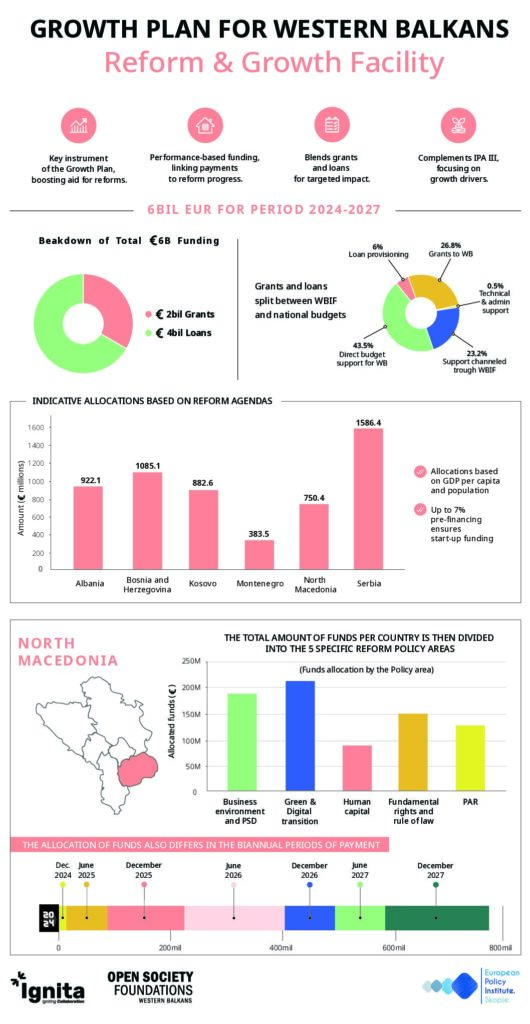
The Reform and Growth Facility (RGF) for the Western Balkans Six (WB6) is a  EUR 6 billion EU instrument designed to support the implementation of structural reforms and investment priorities in each country. The Facility provides EUR 2 billion in grants and EUR 4 billion in concessional loans over the period 2024–2027. It forms the financial arm of the EU’s Growth Plan for the Western Balkans and is directly tied to each country’s implementation of a national Reform Agenda.

Structure of Financing

Total funding under the RGF is set at EUR 6 billion, of which EUR 2 billion is distributed as grants and EUR 4 billion as loans. These funds are allocated across the six WB countries based on a distribution formula laid out in the annexe of the Facility’s founding regulation, which considers population size, needs, and implementation capacity.

At least 50% of the total funding (both grants and loans) is earmarked for investments and will be channelled through the Western Balkans Investment Framework (WBIF). The remainder of the loan envelope will be provided directly to the beneficiaries’ national treasuries as budget support to be used in line with the agreed reform and investment priorities.

Allocation Methodology and Adjustments

The allocation of EU funds under the RGF to each Western Balkan beneficiary is determined in the annexe to the Facility regulation. Each country’s allocated funds are based on a formula that considers both population size and GDP per capita in relation to the regional average. 

Importantly, these allocations are provisional and may be adjusted based on reform performance. Final disbursements are tied to the successful implementation of country-specific Reform Agendas. If a beneficiary fails to meet preconditions, general conditions, or payment benchmarks, the European Commission may reduce or reallocate that country’s funds to better-performing partners. 

Country Indicative Percentual Allocation Indicative Allocation (EUR million) Provisioning for Loans (EUR million)
Albania 16.40% 922.1 59.2
Bosnia & Herzegovina 19.30% 1,085.10 69.6
Kosovo 15.70% 882.6 56.6
Montenegro 6.80% 383.5 24.6
North Macedonia 13.40% 750.4 48.2
Serbia 28.30% 1,586.40 101.8


This performance-based model strengthens accountability and rewards reform progress. A portion of the funds (EUR 30 million) is reserved for technical and administrative support and is excluded from the country-level allocation.
Additionally, EUR 360 million in loan provisioning will be paid into the EU’s Common Provisioning Fund and not disbursed to the beneficiaries.

Facility and Loan Agreements

In order to access the funds, each country must sign two legally binding agreements with the European Commission:

  • The Facility Agreement, which provides the framework for disbursement and sets conditions related to monitoring, reporting, auditing, and evaluation.

  • The Loan Agreement, which outlines the terms of the concessional loan, including repayment schedules, interest rates, and disbursement modalities.

Disbursement of both grants and loans is conditional upon the entry into force of these agreements.

Disbursement Process, Conditionality, and Pre-financing

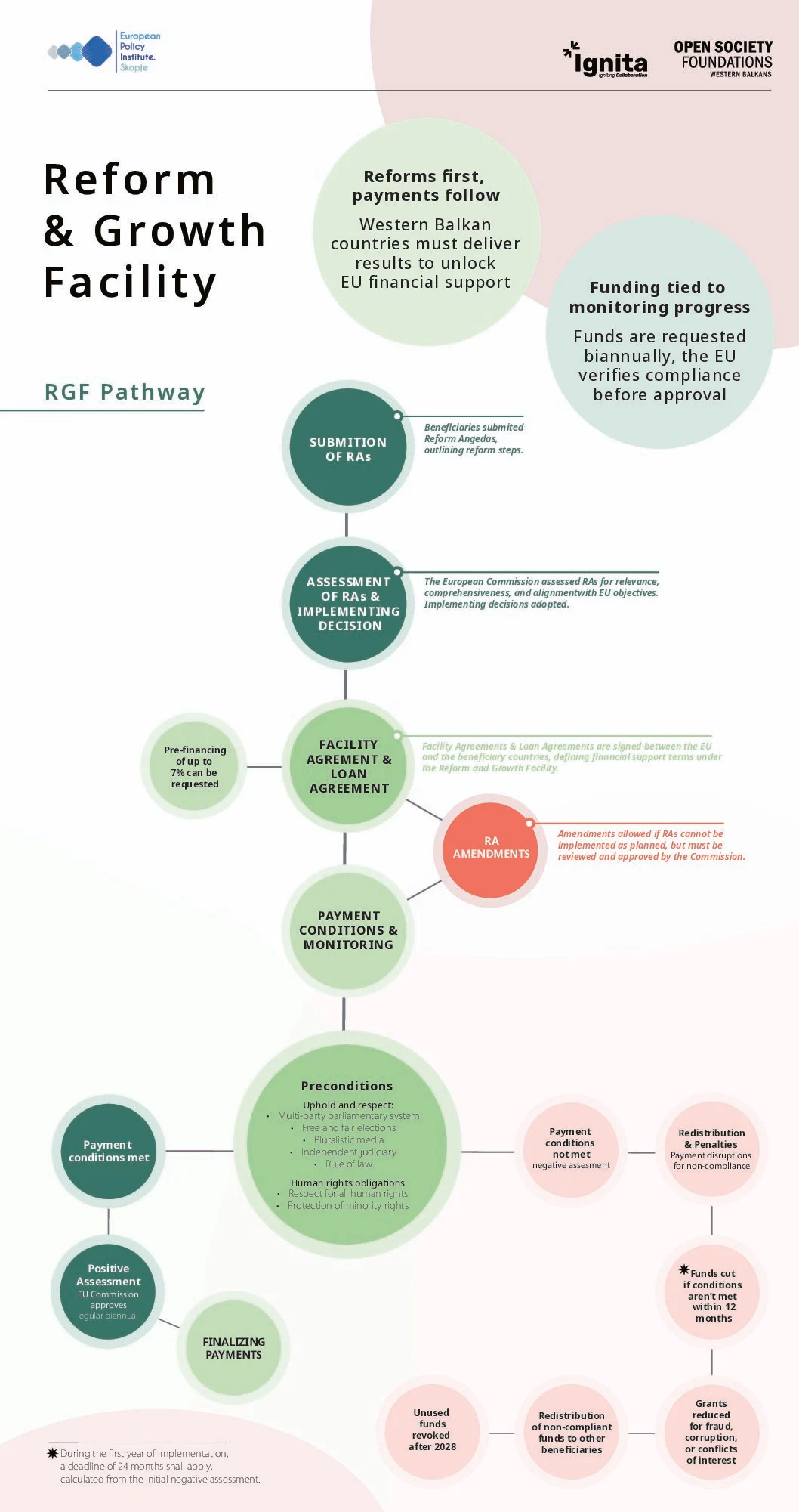
Disbursements from the RGF are performance-based and subject to multiple levels of conditionality. Payments are made twice per year, following a formal request by the beneficiary country and a verification process conducted by the European Commission.

Each national Reform Agenda is divided into quantitative and qualitative benchmarks, referred to as payment conditions. These are time bound and tailored to the country’s reform priorities. The Commission verifies the fulfillment of these conditions before each disbursement.

There are three main sets of conditions:

  • Preconditions, which must be upheld continuously and include adherence to democratic standards. For Serbia and Kosovo, this includes constructive engagement in normalising relations.

  • General conditions, which relate to macro-financial stability, sound public financial management, and budget transparency.

  • Payment conditions, which are specific to each country and are detailed in the Reform Agenda.

Failure to meet any of these conditions can lead to the suspension or reduction of payments.

Beneficiaries may request pre-financing of up to 7% of their total RGF allocation. This pre-financing is intended to support early implementation efforts and is disbursed after the Facility and Loan Agreements enter into force.

Role of the WBIF

The Western Balkans Investment Framework (WBIF) is a central financing and coordination platform under the RGF. At least half of the entire RGF envelope will be channelled through the WBIF to support regional and national investment projects in areas such as transport, energy, digital infrastructure, and environmental protection. The WBIF also provides technical assistance, supports project preparation for implementation, and enables the blending of EU funds with international financial institutions and bilateral donors.

Monitoring and Transparency

The European Commission will assess the implementation of the Reform Agendas twice a year and verify whether the relevant conditions are met before releasing payments. These assessments include desk reviews and on-site verifications. All payments and evaluations will be published online to ensure transparency.

National governments are expected to maintain full transparency in the use of RGF funds, including publishing budget data and cooperating with civil society and oversight bodies. Independent audits and evaluations will also be carried out to ensure compliance and results.

[Infographic] Growth Plan for Western Balkans – Reform & Growth Facility North Macedonia

[Infographic] Reform & Growth Facility