Montenegro: Space for Civil Society in Monitoring the Reform Agenda

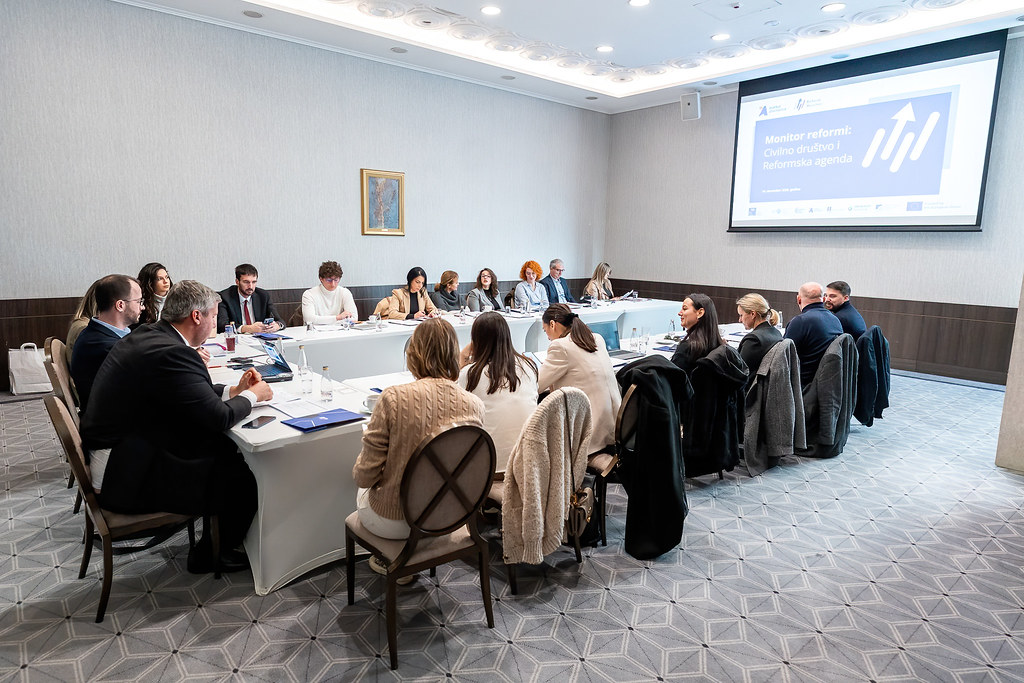
The second meeting of civil society on the implementation of the Reform Agenda 2024–2027 and the Growth Plan for the Western Balkans was held, with assessments that better coordination in reporting is needed, as well as more significant involvement of civil society in verifying the fulfilment of reform steps.

During the meeting, the content of the three most recent semi-annual reports on the implementation of the Reform Agenda was reviewed. Participants pointed out that, although certain information on the implementation of reform steps exists, access to all evidence supporting the Government’s claims is lacking. It was emphasized that data availability is limited, particularly when it comes to documentation that would enable independent verification of the claims presented in the report.

It was concluded that, before the formal submission of reports, higher-quality interinstitutional coordination should be ensured, in order to avoid differences in the understanding of reform fulfilment between the European Commission and the Government of Montenegro. Participants assessed that institutional capacities in this area are still developing, and that a “learning by doing” approach is evident. The need was emphasized for future reports to be less descriptive and more analytical, so that reporting does not represent mere administrative compliance, but becomes a useful analytical tool for monitoring and improving reforms.

During the meeting, it was clarified how the European Commission verifies the Government’s claims regarding the fulfilment of specific steps. It was highlighted that there is no formally defined mechanism for the participation of civil society organizations in the process of verifying the evidence submitted by the Government to support the fulfilment of steps from the Reform Agenda. Nevertheless, there is a recognized willingness and openness to include civil society, particularly when it possesses relevant knowledge about the implementation of specific reform steps.

The meeting is a continuation of our initiative to involve civil society in monitoring the implementation of the Reform Agenda, which we launched with a meeting held last December.
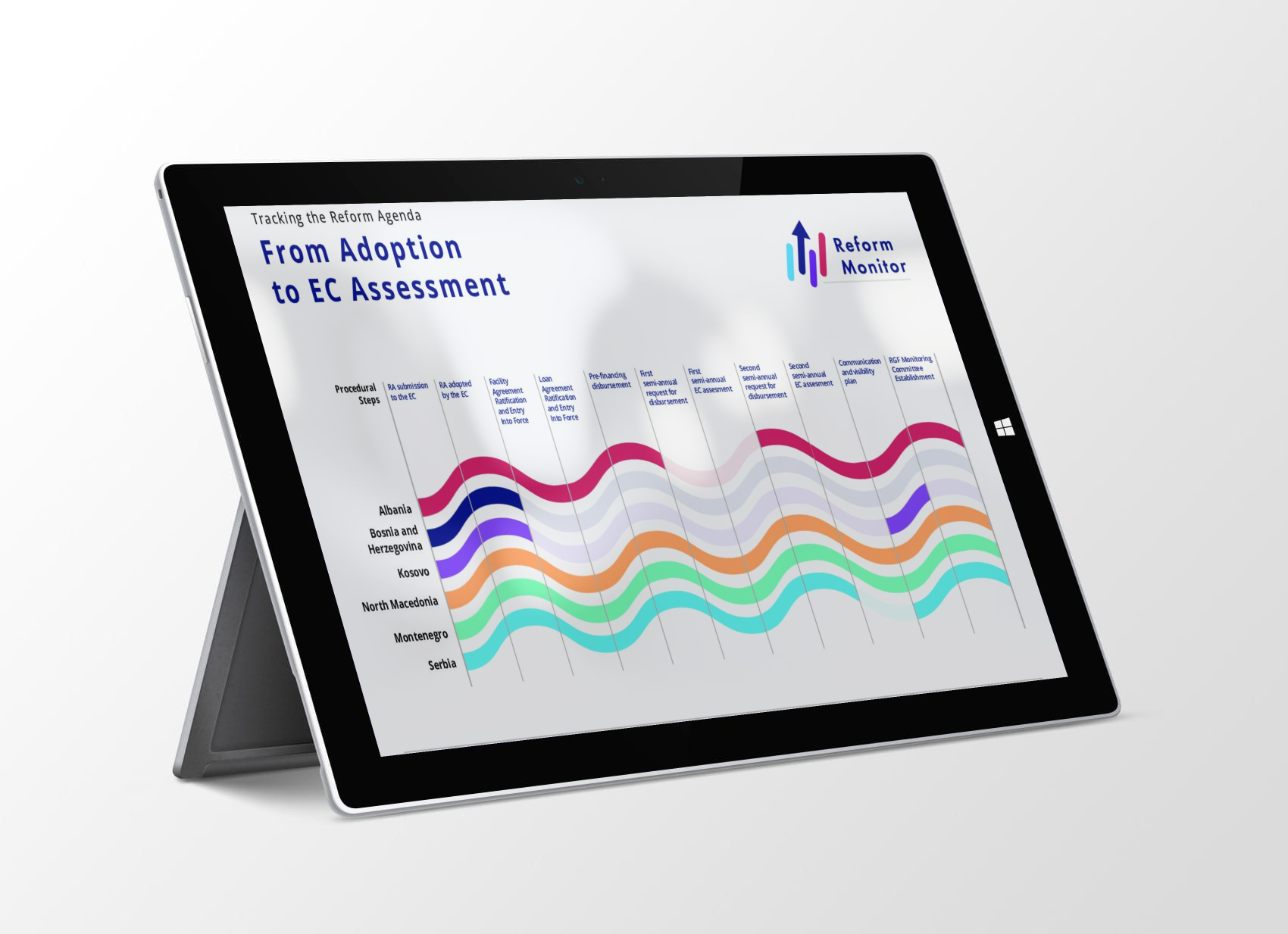
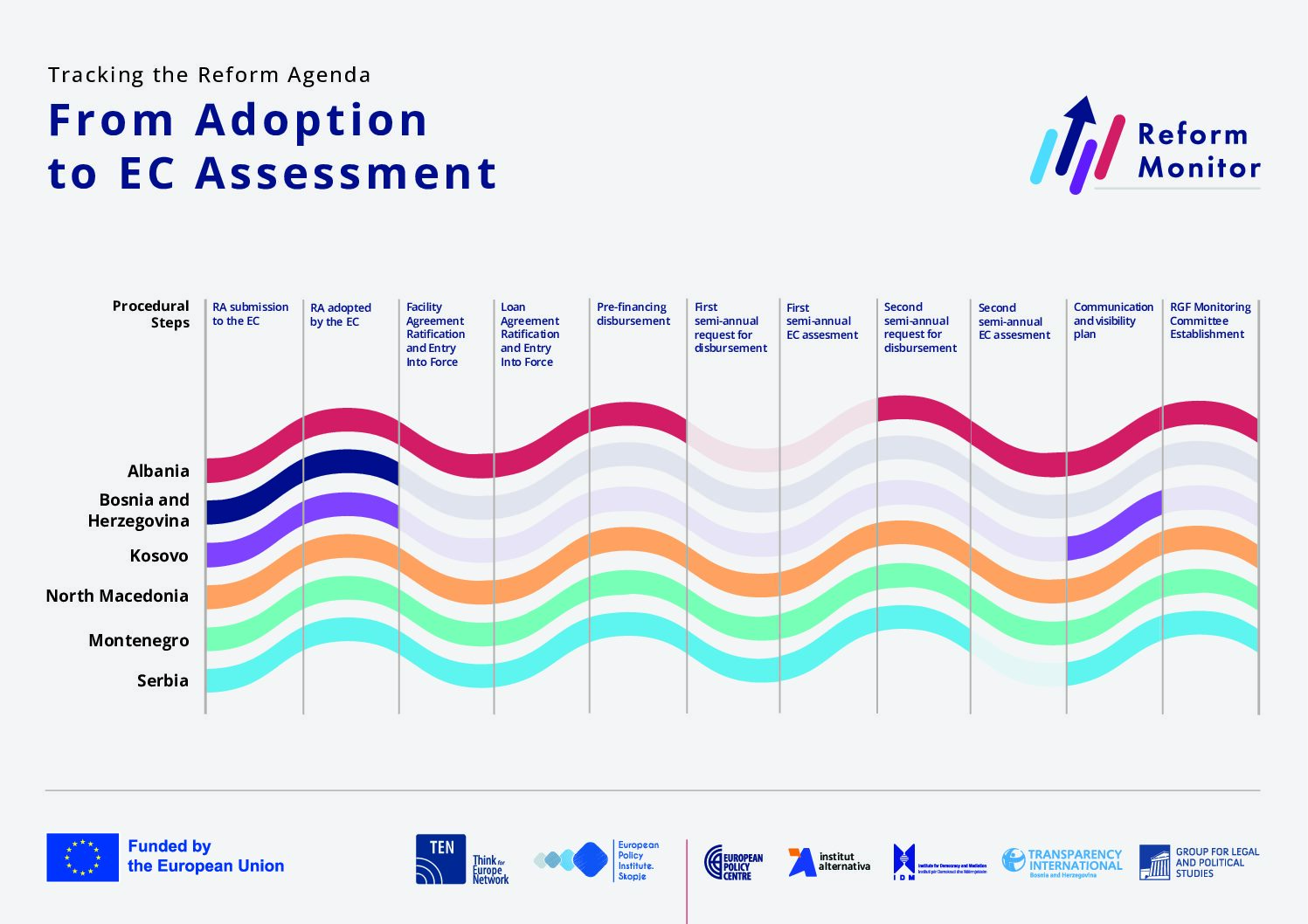
Tracking the Reform Agenda – January 2026 – From Adoption to EC Assessment

The infographic “Tracking the Reform Agenda: From Adoption to EC Assessment” provides a clear and concise visual overview of the key stages in the reform process, from the initial adoption of policies to their evaluation by the European Commission. Designed to enhance understanding of this complex journey, it highlights critical milestones.

Institute Alternative signes Memorandum of Cooperation with the Ministry of European Affairs

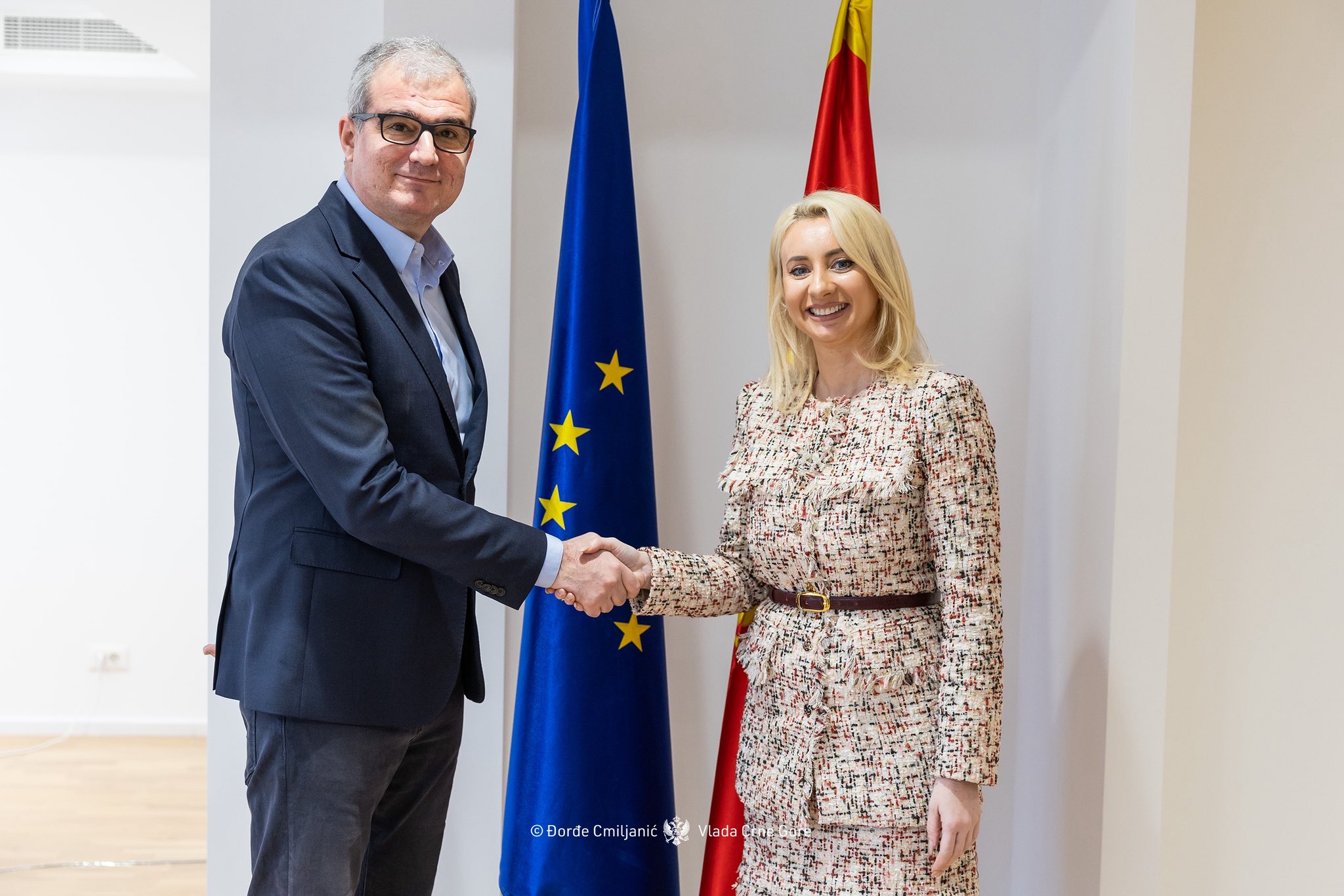
Institute Alternative signed a Memorandum of Cooperation with the Montenegrin Ministry of European Affairs, which will allow oversight and active participation from the civil society in the implementation of the Growth Plan.

This document serves as a formal agreement to collaborate on the monitoring of the Reform Agenda, ensuring that the process remains transparent and inclusive.

This Memorandum is a pivotal step for our project’s objectives. By securing a formal commitment to transparency, Institute Alternative has ensured that the monitoring process in Montenegro will be grounded in accessible, verified data.

This cooperation sets a positive precedent for the Western Balkans region, demonstrating that civil society organizations are essential stakeholders in the accession process.

CSOs and Institutions discussed the Reform Agenda and the Growth Plan in Montenegro

The Institute Alternative organised a meeting on Wednesday, 10 December, dedicated to the implementation of the Reform Agenda 2024–2027 and the Growth Plan for the Western Balkans. The meeting brought together representatives of key institutions responsible for implementing reform measures, as well as representatives of civil society.

Participants included representatives of civil society and institutions coordinating the implementation of the Reform Agenda. The aim of the meeting was to present priorities and challenges in implementing reform steps and to consider ways in which reform processes can most effectively respond to the needs of citizens and the economy. Participants also discussed mechanisms for monitoring the implementation of the Reform Agenda, as well as the dynamics of withdrawing funds available through the Growth Plan for Montenegro. To date, Montenegro has prepared two semi-annual reports on the implementation of a total of 25 reform steps, of which the European Commission has confirmed the implementation of 12. It was noted at the meeting that preparation of the third report is underway, covering 32 new reform steps planned for implementation by December 2025, which will be reported to the European Commission by mid-January.

Žana Jovanović, Head of the Directorate for the Management Structure at the Ministry of Finance, explained details related to financial management, the funds received through the fulfillment of reform steps, and the way in which the Ministry of Finance prepares payment requests. The discussion also covered the preparation of the budget for the following year and the manner in which funds needed for implementing reform steps are planned within the individual financial plans of budget users.

Bojan Vujović, Director General of the Directorate for Coordination of EU Financial Support at the Ministry of European Affairs, answered questions related to challenges in coordinating the implementation of the Reform Agenda, cooperation with representatives of the European Commission, and the way in which the understanding of certain reform steps and activities changes during the course of implementation. The practice of regular meetings between representatives of the European Commission and the Government regarding the alignment of understanding of the current status of reform steps and the determination of their implementation status was also mentioned.

Marko Sošić, Public Policy Researcher at the Institute Alternative, presented findings and observations regarding specific reform measures as part of research conducted with regional partners, with a particular focus on areas where progress has been slower or where additional clarification is needed.

During the meeting, several proposals for further work were formulated. With regard to the need to strengthen transparency, it was requested that the payment requests prepared by the Ministry of Finance on the basis of materials for the semi-annual report be published, as well as the publication of the communication plan for the Reform Agenda that has already been prepared by the Ministry of European Affairs. It is also necessary to consider expanding the Supervisory Committee for the Reform Agenda to include interested representatives of civil society, beyond the already appointed permanent members. With regard to financial transparency, it was recommended to consider opening separate budgetary programs for financing the implementation of reform steps, in order to enable easier monitoring of the planning and spending of funds for this purpose. Particular emphasis was placed on the need to strengthen transparency in the component related to infrastructure projects – the way projects are selected, prepared for application, submitted to the WBIF, and how their status and financing are monitored.

The meeting represents a step toward better information sharing and greater openness toward citizens and civil society regarding the implementation of the Reform Agenda and the Growth Plan, with the aim of ensuring that reform processes deliver concrete and measurable benefits to the citizens and economy of Montenegro.

Reformska agenda i civilno društvo - Prvi sastanak

Tracking the Reform Agenda – October 2025 – From Adoption to EC Assessment

The infographic “Tracking the Reform Agenda: From Adoption to EC Assessment” provides a clear and concise visual overview of the key stages in the reform process, from the initial adoption of policies to their evaluation by the European Commission. Designed to enhance understanding of this complex journey, it highlights critical milestones.

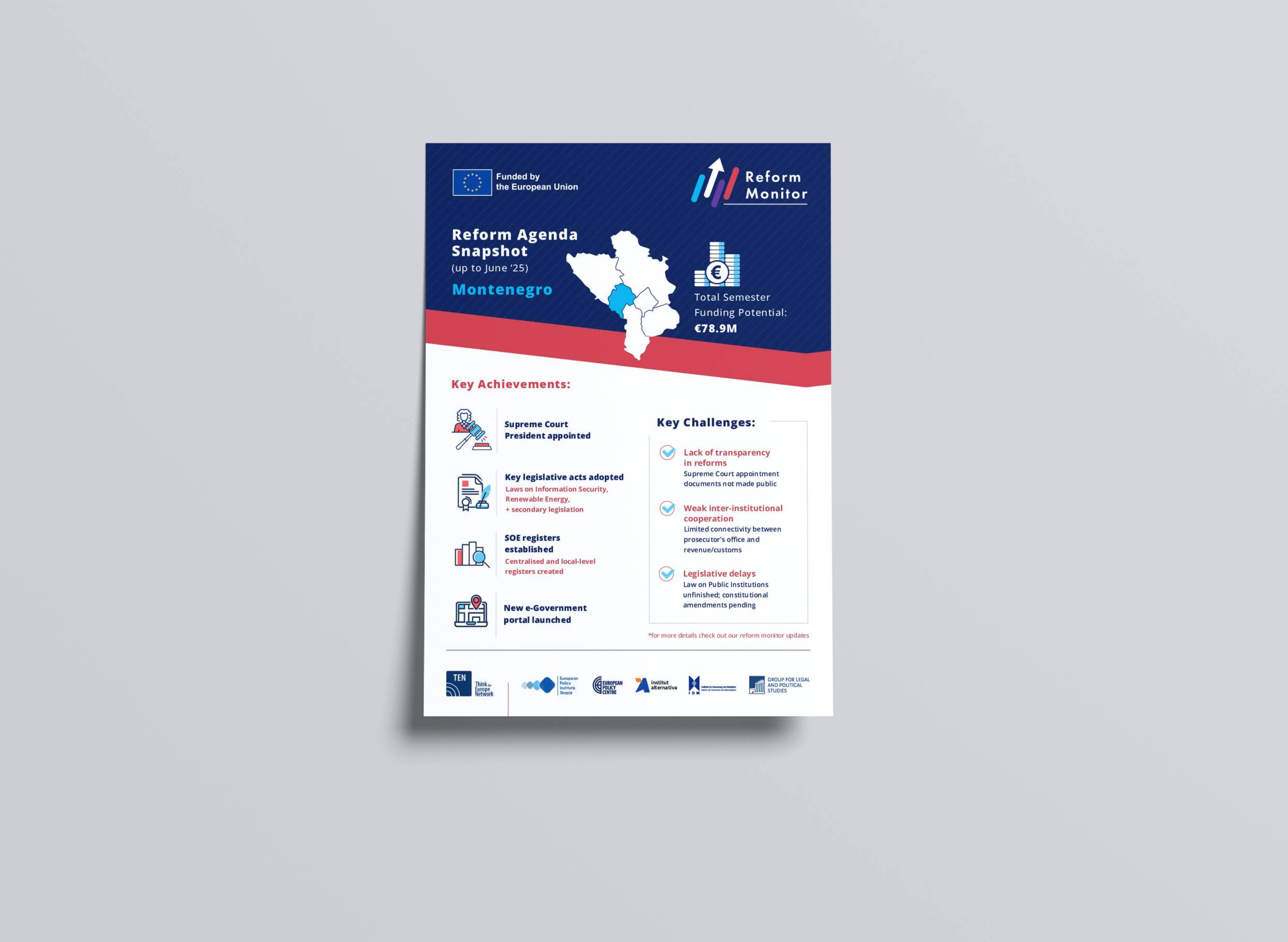
Reform Agenda Snapshot (Јune ‘25) – Montenegro

This infographic provides an overview of Montenegro’s Reform Agenda implementation up to June 2025, highlighting progress made, pending measures, and key challenges across priority areas.

Reform-Agenda-Snapshot-up-to-june-‘25_Montenegro-1

Montenegro Reform Agenda – Accumulation of Obligations and Unpaid Funds

So far, Montenegro has withdrawn just over one third of the funds that were available for the successful implementation of the Reform Agenda. Reports by the European Commission point to unreliable reporting and slow progress in meeting targets, while measures “on hold” continue to accumulate.

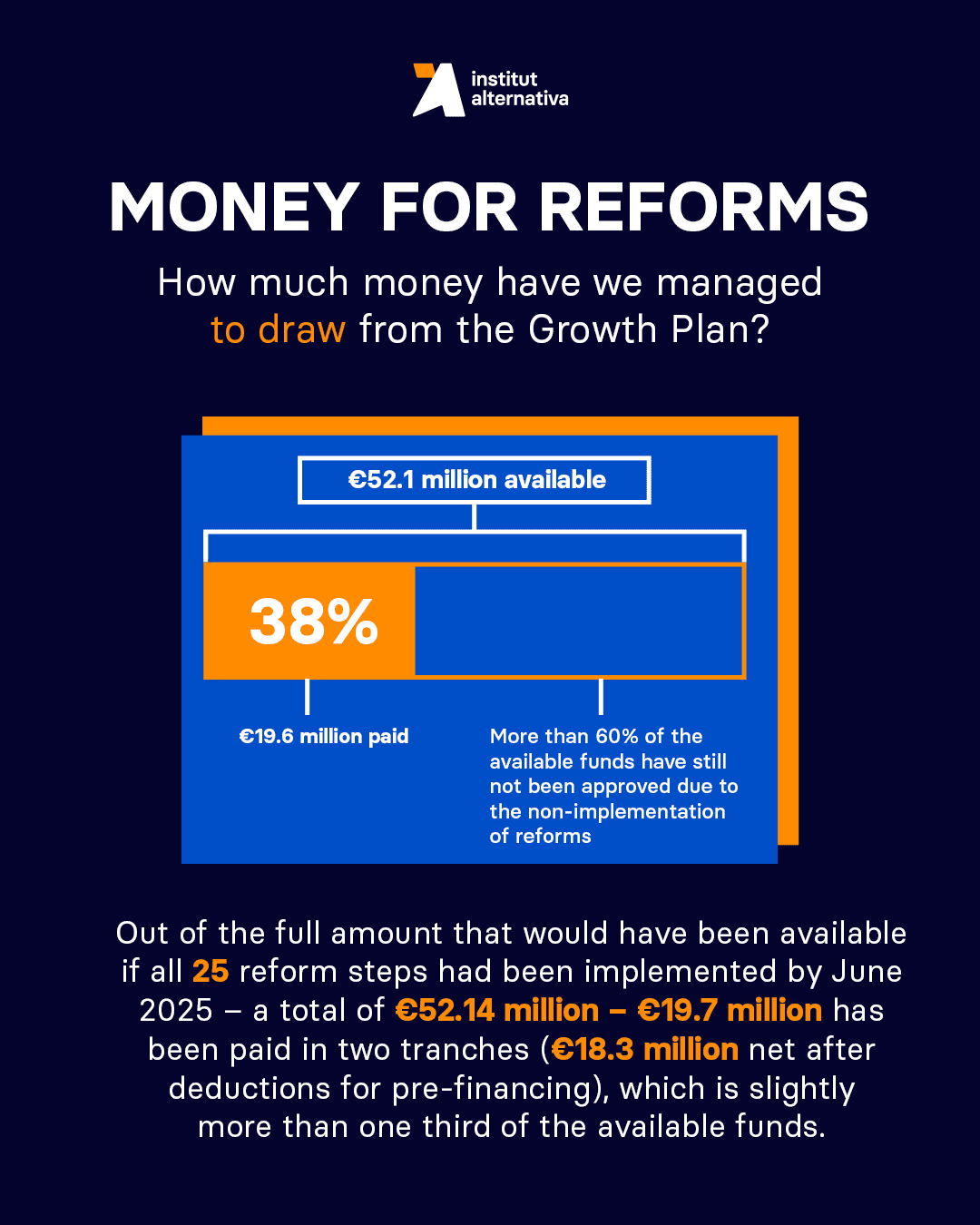
Although the disbursement of the first and second tranches of the Reform Agenda has been proclaimed a success by our officials, European Commission reports highlight worrying problems regarding the accuracy of government reporting, the accumulation of unimplemented reform steps, and the fact that we have so far managed to draw only slightly more than one third of the available funds, the payment of which is conditional on the implementation of reforms.

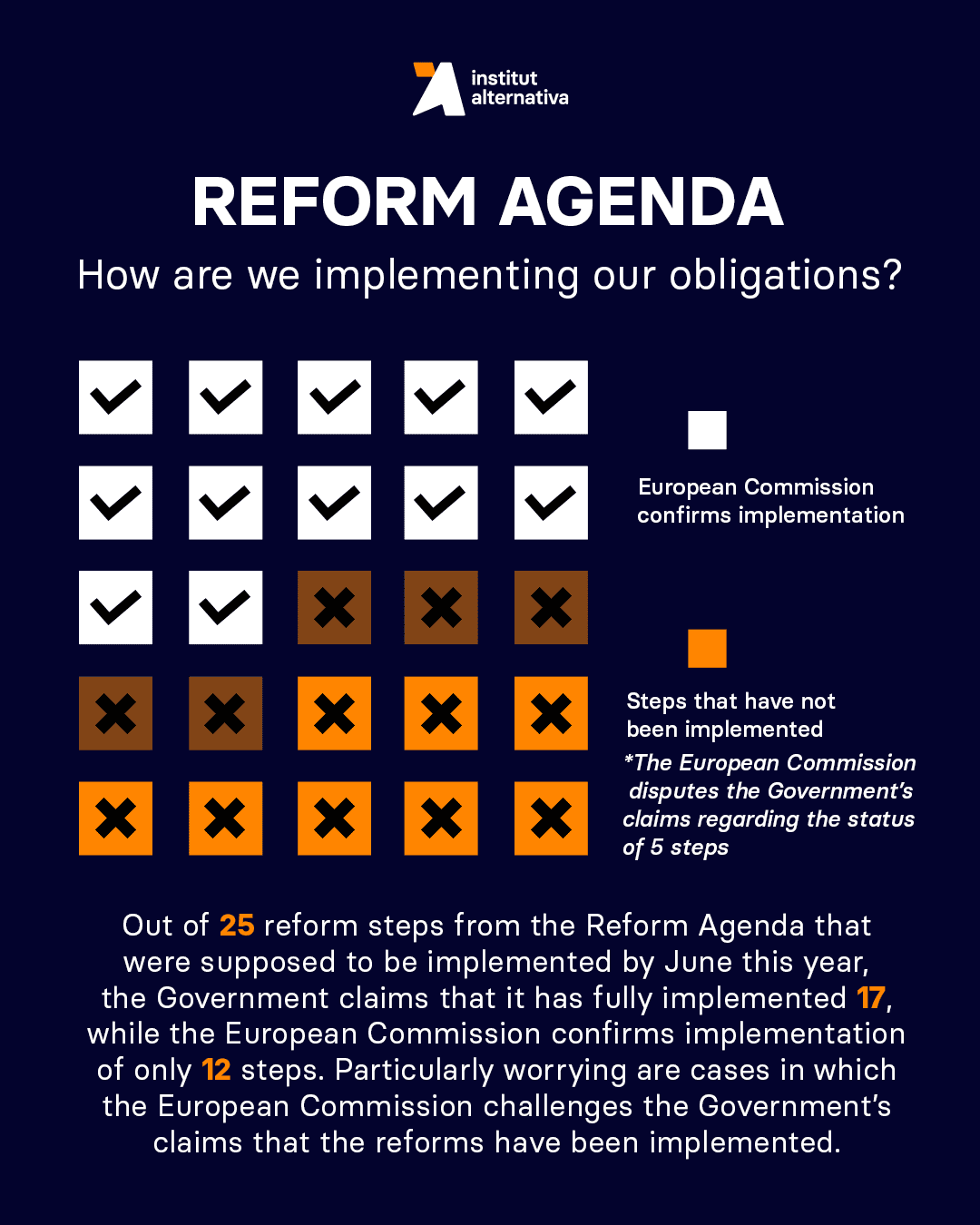
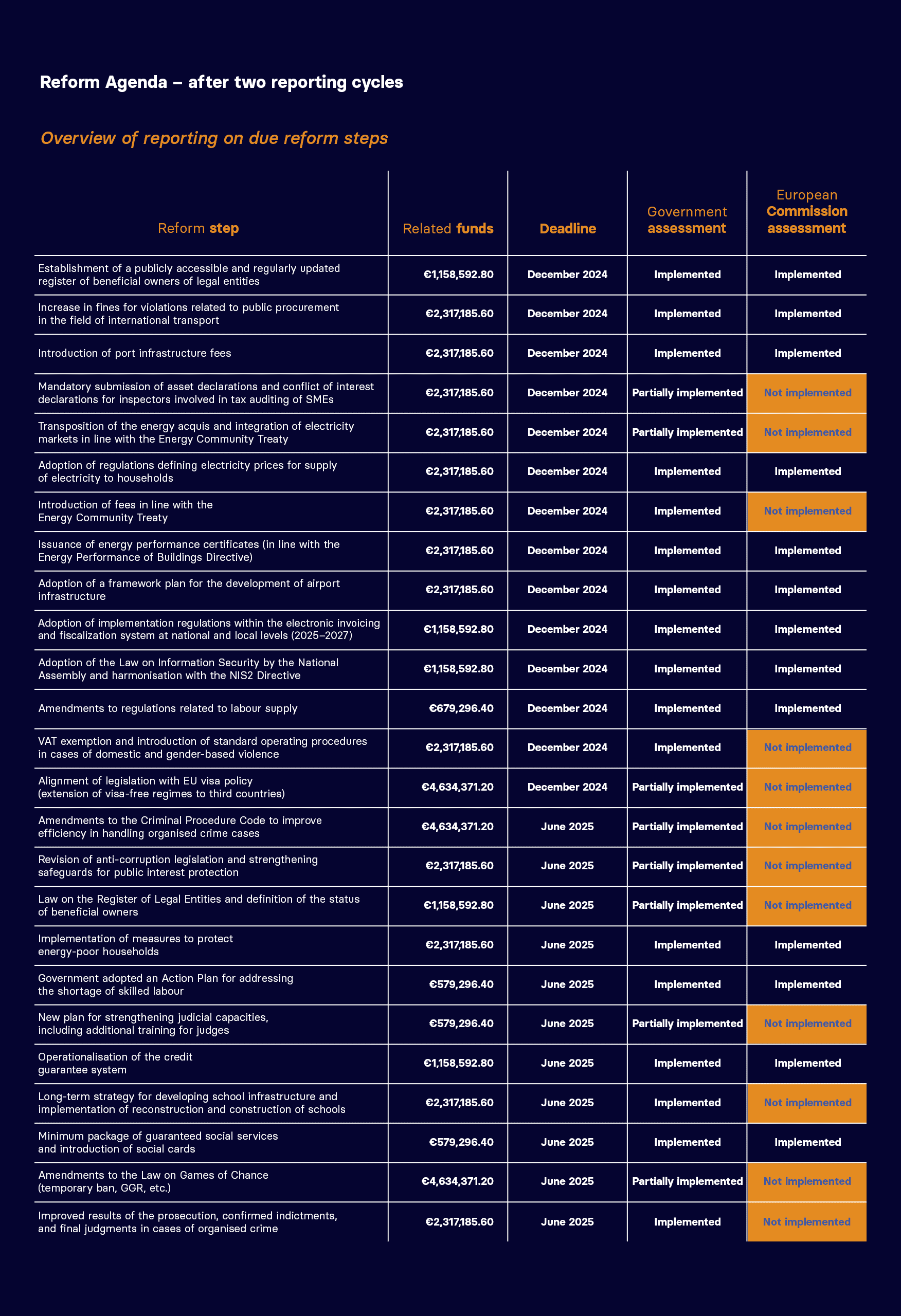
Out of 25 reform steps from the Reform Agenda that were supposed to be implemented by June this year, the Government claims that 17 have been fully implemented, while the European Commission states that only 12 steps have been completed.

This also affects the funds withdrawn – out of the full amount that would have been available had all 25 reform steps been implemented – a total of €52.14 million – €19.70 million gross has been paid, or €18.26 million net after deductions for pre-financing. This represents only about 38% of the available funds.

Particularly worrying are cases where the European Commission’s assessment does not align with the Government’s evaluation of the level of reform implementation.A good example of the disagreement between the Government and the European Commission is the reform step related to connecting the Special State Prosecutor’s Office (SSPO) and granting access to the databases of institutions it cooperates with, the completion of which would bring €2.1 million. The Government lists this measure as fully completed, while the European Commission assesses that the measure has not been implemented because three key databases are still not directly accessible to the SSPO: the Tax Administration’s records of issued and received invoices of legal entities; data from the Central Bank on indebtedness, transactions, and account blockages; as well as transaction data available to the Central Bank and historical cadastral data from the Real Estate Administration.

In other words, the Government officially claims that full compliance has been achieved, while the European Commission, through its detailed review, refutes the Government’s claims and, accordingly, only partially approves the disbursement of funds. A similar pattern appears in steps related to energy, digitalization, the rule of law, and corporate governance. In the same way, disagreements have arisen regarding the assessment of the fulfillment of measures for a total of 13 reform steps (out of 25 in total), for which the Government claims full or partial implementation, while the European Commission, through analysis of the submitted evidence and its assessment, concludes that they have not been achieved.The discrepancy comes down to the same rule – the European Commission requires thoroughly proven functionality and maintains the assessment “not achieved,” resulting in partial payments that are significantly below the available amount. These cases precisely explain why only part of the funds from the Growth Plan has been withdrawn so far.

The funds that have not yet been paid are not lost, as there is a one-year “grace period” during which they can still be withdrawn if the reforms are implemented. However, it should be borne in mind that by December of this year an additional 32 steps must be implemented, potentially bringing €83.4 million. Therefore, in addition to the unfinished obligations carried over since December last year (a total of 13 measures), by the end of the year we also have 32 new measures for which we will have to report to the European Commission on what has been done. The accumulation of obligations in the first year of implementing the Reform Agenda testifies to a lack of capacity and insufficient commitment of the competent institutions to implement the reforms they themselves proposed within the defined deadlines.

Marko Sošić

Photo: Gemini

Crna Gora- Pregled ispunjenosti Reformske agende: Pilot-monitor reformi

Ovaj Pregled ispunjenosti Reformske agende: Pilot-monitor reformi prvi je u nizu nacionalnih izvještaja o monitoringu u okviru projekta „Monitor reformi”. 

Prvi Pregled ispunjenosti Reformske agende – Pilot-monitor reformi je preliminarno ažuriranje namijenjeno kao opšti presjek stanja (i napomena!) koji se objavljuje sredinom godine, a ne kao detaljna evaluacija. Kako projektni tim probno primenjuje metodološki pristup i indikatore, nove izmjene u narednim sedmicama mogu promijeniti status reformi koje su trenutno na čekanju. 

Monitor reformi prati implementaciju odabranih reformskih koraka iz Reformskih agendi. Odabrani koraci reformi organizovani su u takozvanim „sektorima politike” koji spadaju u oblasti i pod-oblasti politika obuhvaćenih Reformskom agendom. Ovi „sektori politike” su utvrđeni nakon dodatne identifikacije reformi i kodiranja reformskih koraka koje je obavio projektni tim. Ovakav pristup je izabran radi fokusa na reformskim koracima zajedničkim cijelom regionu Zapadnog Balkana, kako bi se omogućile analize na regionalnom nivou, postavljanje istovjetnih mjerila i uporedivost, s obzirom na raspoložive ljudske resurse i tematsku ekspertizu TEN mreže. Za metodološke napomene i proces odabira reformskih koraka, pogledajte napomenu o nacrtu metodologije. 

Ovo probno ažuriranje podataka o ispunjenosti Reformske agende prati strukturu usklađenu sa metodologijom projekta „Monitor reformi“, koja obuhvata: (1) Izvršni sažetak; (2) Proceduralnu usklađenost sa Instrumentom za reforme i rast; (3) Status realizacije reformskih koraka po sektorima politike; i (4) Narativ i analizu ključnih pozitivnih koraka i izazova. Svaki odjeljak daje pregled ostvarenog napretka i prepreka u vezi sa sprovođenjem Reformske agende Crne Gore.

Napomena: Rok za prikupljanje podataka i procjenu u okviru ovog ažuriranja je 30. jun 2025. godine. Događaji koji su uslijedili nakon ovog datuma nijesu obuhvaćeni ovim izvještajem, već će biti razmotreni u narednim ažuriranjima.

RA_Pilot-Reform-Monitor_Montenegro_First-Semester-2025_As-of-June-2025-1

Download

EC approves second release of funds for Albania, Montenegro and North Macedonia under the Western Balkans Growth Plan

On 16 October 2025, the European Commission published the second implementing decision for the release of funds to Albania, Montenegro, and North Macedonia under the Reform and Growth Facility for the Western Balkans, part of the broader Growth Plan.

The Commission’s decisions are based on evaluations of compliance with political preconditions, macro-financial stability, and specific reform commitments outlined in each country’s Reform Agenda. The release follows positive assessments of reform progress and macroeconomic conditions in the three countries, and partial implementation of specific reform steps under the Reform Agendas.

The Commission’s implementing decision approving release of funds to Albania, Montenegro and North Macedonia under the Reform and Growth Facility for the Western Balkans is avaliable here.

Albania

The European Commission found that  21 out of the 41 payment conditions related to the reform steps as set in its request and in its Reform Agenda are fulfilled by Albania. With that, the country will receive its first release of €99,323,541.9 net (post-pre-financing clearance): € 28,504,617.19 in non-repayable grants and € 70,818,924.71 in loans, with 34.75% (€ 24,609,576.34) allocated to the Western Balkans Investment Framework (WBIF). This disbursement comes in recognition of Albania’s progress on key governance and economic reforms, including public administration reform, judicial efficiency, and digitalisation of public services. Specific projects under WBIF will focus on enhancing sustainable transport networks and clean energy initiatives.

The Assessment of the Conditions for Payments is available here.

Montenegro

The European Commission found that  5 out of 18 payment conditions related to the reform steps as set out in its second request for disbursement are fulfilled by Montenegro with a deadline due June 2025. In total, Montenegro fulfilled 12 reform steps so far. With that, the country will receive its second release of funds of € 8,083,884.46 net (post-pre-financing clearance): € 2,319,973.97 in non-repayable grants and € 5,763,910.49 in loans, with 34.75% (€ 2,002,958.90) allocated to the Western Balkans Investment Framework (WBIF). 

This release follows the country’s successful implementation of reforms in public sector transparency, digital transition, and energy efficiency. Notably, Montenegro has improved the accessibility of data on State-Owned Enterprises (SOEs) and adopted several key laws aligned with EU directives, such as the Law on Information Security in line with the NIS2 directive. 

The Assessment of the Conditions for Payments is available here.

North Macedonia

The European Commission found that  4 of of 16 payment conditions with a deadline due June 2025 are fulfilled by North Macedonia, or in total 6 out of 21 for both semesters. With that, the country will receive its second disbursement of  €15,929,721.7 net (post-pre-financing clearance): € 4,571,631.37  in non-repayable grants and € 11,358,090.36 in loans, with 34.75% (€ 3,946,936.40 ) allocated to the Western Balkans Investment Framework (WBIF). The country demonstrated progress in corporate governance, internal financial controls, and justice sector reforms, although key challenges remain, particularly in the fight against high-level corruption and political interference in the judiciary.

The Assessment of the Conditions for Payments is available here.

Next Steps

The facility rewards the beneficiaries who demonstrate measurable progress in implementing their Reform Agendas in areas like the rule of law, governance, green and digital transitions, and public financial management.

Assessments for Serbia are not yet published, and the country has not yet received funding under the RGF apart from the prefinancing that beneficiaries received. In contrast, Kosovo has not yet ratified the necessary agreements, and Bosnia and Herzegovina is awaiting the Commission’s approval of its Reform Agenda.

You can find further documents and implementing decisions in the Documents section of our website.


Montenegro Reform Agenda Update – Pilot Reform Monitor

This Reform Agenda Update: Pilot Reform Monitor is the first in the series of national monitoring reports within the Reform Monitor project.

This first  Reform Agenda Update: Pilot Reform Monitor is a preliminary update intended as a mid-semester snapshot (alert!) rather than a detailed evaluation. As the project team pilots the methodological approach and the indicators, further policy developments in the coming weeks may shift the status of currently pending reforms.

The Reform Monitor tracks the implementation of selected reform steps from the Reform Agenda. The selected reform steps are organised in so-called “policy domains” that fall within the policy areas and sub-areas of the Reform Agendas. These “policy domains” are developed following an additional level of reform identification and coding of reform steps by the project team. This approach was chosen to focus on reform steps common across the WB region and to enable regional-level analyses, benchmarking and comparability, given the available human resources and the thematic expertise of the TEN network. For methodological notes and the reform steps selection process, see the draft methodology note.  

This Pilot Reform Agenda Update follows a structure aligned with the Reform Monitor’s methodology, covering: (1) a high-level Executive Summary; (2) procedural compliance under the RGF; (3) reform steps implementation status per policy domain; and (4) narrative and analysis of key progress and challenges. Each section provides a snapshot of progress and obstacles related to Montenegro’s Reform Agenda implementation.

Please note that the cut-off date for data collection and assessment for this update is 30 June 2025. Developments occurring after this date are not reflected in this report but will be considered in subsequent updates.

RA_Pilot-Reform-Monitor_Montenegro_First-Semester-2025_As-of-June-2025-1

Download