The European Commission has adopted an Implementing Decision approving the first release of funds to Serbia under the Reform and Growth Facility (RGF) for the Western Balkans. The decision follows the Commission’s assessment of Serbia’s compliance with the Facility’s preconditions, general payment conditions, and the achievement of reform steps due by December 2024.
EC implementing decision
EC assessment
Follow the money: Funds are released, disbursement may wait
Under this Implementing Decision, the Commission approved a net amount to be released under this first payment request of around EUR 56.55 million, of which 16.23 million is in grants and 40.32 million is in loans. The total gross amount is EUR 61.1 million, comprising if of 17.55 million in non-repayable financial support (grants) and EUR 43.60 million in loan support. Part of the instalment is used to clear advances i.e. the pre-financing of 7% foreseen for all beneficiaries under the RGF.
In line with the Facility and Loan Agreements, the approved funds will be transferred through the two main channels. The grant component will be made available through the Western Balkans Investment Framework (WBIF) and paid conditional on the conclusion of contribution arrangements and the submission of payment requests by the WBIF fund managers – EIB and the EBRD. This means that the EC implementing decision itself does not imply immediate cash transfers in form of grants. The loan component, on the other hand, is split into two components. Around EUR 14.0 million, or 34.75%, is earmarked for WBIF-linked investments and subject to separate contribution arrangements, while a sum of around EUR 26.3 million will be disbursed directly to Serbia’s Treasury.
Pre- and general conditions met: cautious but accommodating interpretation
The Commission concluded that the pre-conditions and general conditions for payment are met, including democratic governance, rule of law, macroeconomic stability, and public financial management. This assessment is made despite explicit concerns noted in the same document, including persistent political polarisation and pressure on independent institutions, and ongoing challenges related to judicial independence, citizens’ and media freedom.
The release of funds is also conditional on Serbia’s constructive engagement in the EU-facilitated dialogue with Kosovo, which constitutes a specific precondition for these two countries under the RGF. In its assessment, the Commission concludes that this precondition is fulfilled, based on Serbia’s continued participation in the dialogue and input provided by the European External Action Service.
Reform delivery: Success in green and digital, delays in “Fundamentals”
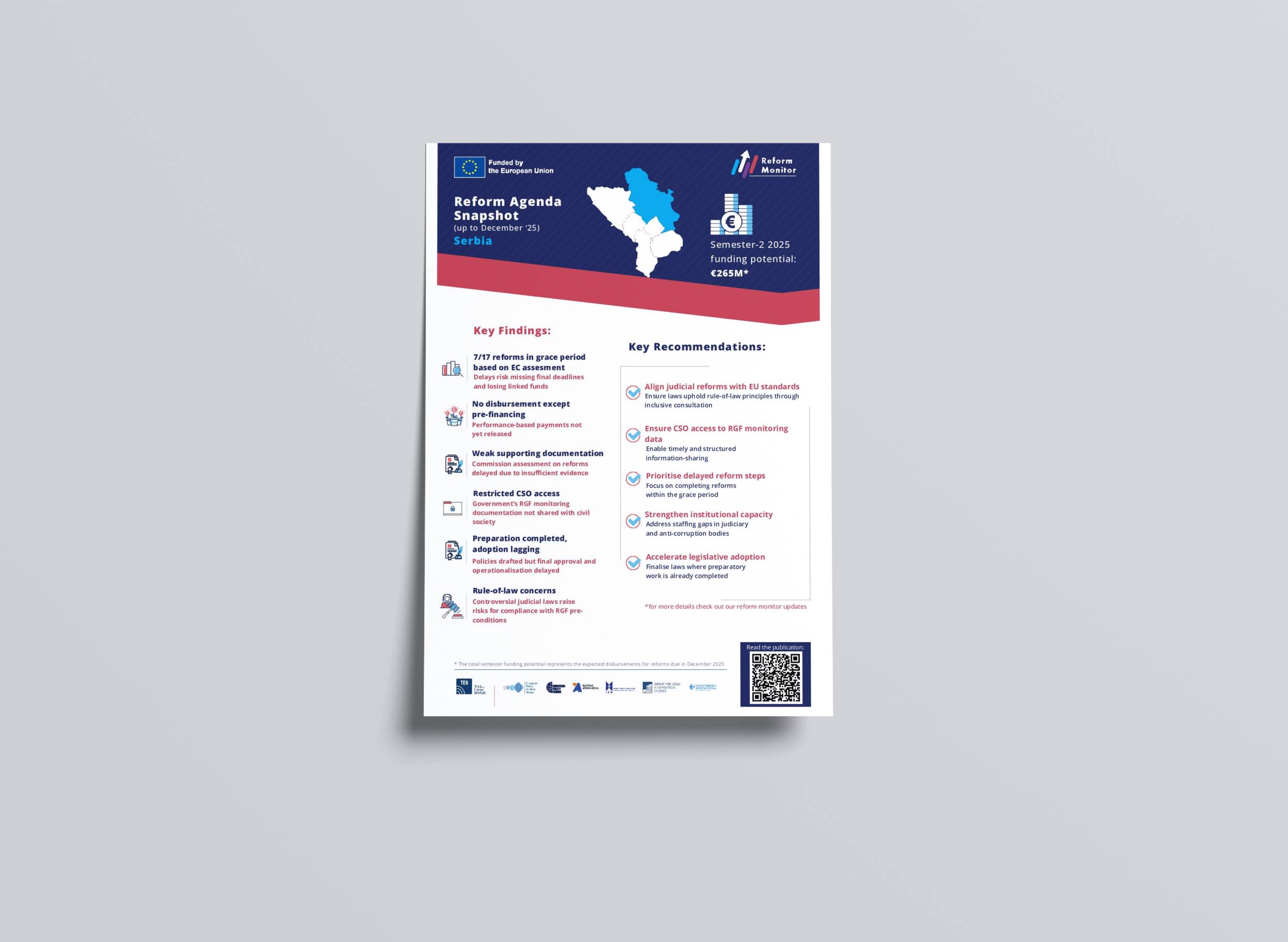
Out of seven reform steps that were due in December 2024, assessed under Serbia’s first payment request, 3 reform steps were assessed as fully achieved, and 4 steps were assessed as not achieved.
The partial reform delivery of Serbia’s Reform Agenda comes with the Commission confirmation that the reform steps relating to the electricity market integration with key steps taken toward day-ahead market coupling with regional partners and EU, the adoption of a bylaw transposing the EU Toolbox for 5G Security and the termination of visa-free access for at least three third countries in view of alignment with the EU visa regime.
On the other hand, three of the four steps that have not been achieved are in the area of “Fundamentals”. It should be noted that this assessment reflects the situation at the moment when Serbia submitted its request for payment and does not fully capture subsequent developments. In particular, this is relevant in two cases. First, regarding media legislation, the assessment refers to the period prior to the adoption of key media laws, notably amendments to the Law on Electronic Media, the Law on Public Information and Media, as well as the adoption of the Law on Public Service Media, which were adopted subsequently and whose progress is acknowledged in the EC Serbia 2025 Report. The remaining unfulfilled steps relate to electoral framework reforms, notably the functioning of the ODIHR-recommended working group, the voter register audit, and the re-election of the REM Council as well as, in the domain of anti-corruption with the requirement for Serbia to adopt an action plan covering the entirety of the anti-corruption strategy implementation (2025–2028). In the area of state aid transparency, the inventory submitted by Serbia at the time of the payment request did not fully address earlier Commission comments and was therefore considered not achieved. However, the adoption of the final state aid inventory was later confirmed in the EC Serbia 2025 Report.
Already behind schedule: Delays and backloging crucial reforms
This implementing decision and assessment arrive later than those for other beneficiaries in relation to the December 2024 reform deadlines. For example, North Macedonia and Montenegro received their corresponding decision in July 2025, which highlights uneven pacing in the Commission’s assessment and decision-making across beneficiaries.
At the time of adoption of this implementing decision, the assessments of the June 2025 reform steps are still pending, for which Serbia has 10 additional reform commitments. Furthermore, the deadline to report on the December 2025 deadlines passed was 15 January 2026, covering a further 20 reform steps. This sequencing highlights the pressure for reform delivery as Serbia is advancing into the next reform cycles while assessments of earlier deadlines remain pending.
For all non-achieved steps due in December 2024, the grace period runs until 31 December 2026. During this period, Serbia may still complete the outstanding reforms without an immediate financial penalty. However, as explained above, these postponed reforms increase the pressure for administration to deliver an increasing number of reforms over time that may affect future payment requests.
Photo: © European Union, 2026, CC BY 4.0, via Wikimedia Commons

![[Podcast] Kako Reformska Agenda oblikuje budućnost Srbije?](https://reform-monitor.org/wp-content/uploads/2026/05/podcast-bojana-selakovic.png)




.jpg)