Препораки од третиот состанок на Националниот консултативен механизам за реформската агенда (НКМ-РА)

Препораките произлегуваат од паралелните дискусии во рамките на Третиот состанок на НКМ-РА кој се одржа на 14.05.2026 г. во хибриден формат, со учесници присутни во Клубот на пратеници во Скопје и онлајн. Овој состанок претставува клучна точка за евалуација на досегашните реформски чекори и координација помеѓу државните институции и граѓанското општество, а е во организација на Институтот за европска политика (ЕПИ) – Скопје и Министерството за европски прашања (МЕП). Состанокот е активност која е дел од регионалниот проект „Следење реформи и раст во Западен Балкан“ (WB Reform and Growth Monitor), што го спроведува ЕПИ во партнерство со членките на мрежата „Мисли за Европа“ (Think for Europe Network – TEN) и Транспаренси Интернешнл Босна и Херцеговина. Проектот е финансиран од Европската унија и кофинансиран од Фондацијата Отворено Општество-Западен Балкан.


Final-recommendations-3rd-NKM-RA.docx

EPI: CSOs should have a structured and meaningful role in the RGF Monitoring Committee

The European Policy Institute – Skopje participated in the second meeting of the Monitoring Committee for the Reform and Growth Facility (RGF), with representatives of the European Commission, the Delegation of the European Union, national institutions, civil society organisations and international partners.

The meeting focused on reviewing the implementation of North Macedonia’s Reform Agenda and discussing how different stakeholders can contribute to ensuring that reforms supported through the RGF deliver visible and measurable results.

EPI contributed to the discussion by presenting key messages and recommendations developed through its monitoring work and the National Consultative Mechanism for the Reform Agenda (NKM-RA), implemented as part of the regional “WB Reform and Growth Monitor” project. EPI noted that regional exchange can help identify useful models and good practices for addressing the shared challenge of structured civil society participation.

Our researcher, Fikrija Tair Selmani, emphasised that, for CSOs’ contribution to be meaningful, the valuable role of civil society as a constructive partner in the Reform and Growth Facility process should be further acknowledged and supported through structured participation. She also underlined that, through policy knowledge, field-based experience and evidence, civil society organisations can support institutions in identifying implementation challenges, improving the quality of reforms and ensuring that progress is reflected in concrete benefits for citizens, businesses and institutions.

She recalled that civil society participation in the Monitoring Committee is regulated by the Rules of Procedure, which allow structured participation as well as direct invitations. Following this framework, the invitation and selection process should be inclusive and transparent, based on credible criteria. Building on positive practices from the region, CSOs should be more systematically engaged in monitoring and policy dialogue processes, including through written contributions, comments and recommendations before and after Committee meetings, in addition to spoken input during the meetings.

She also emphasised that timely access to all relevant documents before and after meetings is essential for meaningful participation, including supporting materials, conclusions and follow-up documents. More broadly, the challenge goes beyond North Macedonia and is relevant across the region. The Monitoring Committee therefore has an opportunity to set a positive example of transparent and inclusive monitoring by including CSO representatives as members, with clearly defined roles, rights and responsibilities. Such an approach would contribute to the quality of dialogue and help ensure that reform implementation is monitored in an inclusive, evidence-based and results-oriented manner.

In this context, several recommendations were highlighted for strengthening civil society participation in the work of the Monitoring Committee:

  • Establish formal CSO representation in the Monitoring Committee, with clearly defined roles, rights and responsibilities.
  • Ensure inclusive and informed participation by providing timely access to relevant information and space for both written contributions and spoken CSO input.
  • Strengthen transparency and follow-up by publishing key documents and explaining how recommendations are considered.

EPI remains committed to supporting an open, inclusive and evidence-based dialogue on the implementation of the Reform Agenda, contributing to efforts to ensure that the Reform and Growth Facility delivers tangible and sustainable benefits for citizens, businesses and institutions.

The European Commission releases €158.9 million to Albania, Montenegro and North Macedonia

The European Commission has today made available €49 million to Albania, €44.2 million to Montenegro, and €65.7 million to North Macedonia under the Reform and Growth Facility. This follows the third request for payment and the Commission’s positive assessment of reform steps implemented in the areas of business competitiveness and innovation in Albania and Montenegro, and education and digitalisation in North Macedonia.

With today’s release, the total amount released under the Facility under their respective envelopes reaches €212.8 million for Albania, €89.3 million for Montenegro, and €142.1 million for North Macedonia.

Progress under the Reform Agendas

In Albania, the reforms assessed by the Commission include measures to improve the business environment, facilitate investment and innovation, and expand access to finance, including for start-ups and companies active in the green and digital sectors. Of the €49 million disbursed, €22.8 million will be transferred to the state budget, while the remaining funds are made available for investment projects through the Western Balkans Investment Framework (WBIF), subject to the applicable approval procedures. The official assessment by the EC is available in the Official documents part of our website.

You can check the latest Refrom Monitor’s Reform Agenda Update for Albania at: https://reform-monitor.org/albania-reform-agenda-update-2nd-semester-2025/

In Montenegro, the Commission assessed reforms in the area of research and innovation, including support for scientists, businesses and research institutions, as well as further strengthening of the national innovation ecosystem. Of the €44.2 million disbursed, €20.6 million will be transferred to the state budget, while the remaining funds are made available for investment projects through the WBIF. The official assessment by the EC is available in the Official documents part of our website.

The last Reform Agenda Update prepared as part of our project is avaliable at: https://reform-monitor.org/montenegro-reform-agenda-update-2nd-semester-2025/

In North Macedonia, the reforms assessed include measures to improve the financing of primary and secondary education and measures in order to expand access to digital infrastructure and IT equipment in schools. Of the €65.7 million disbursed, €30.6 million will be transferred to the state budget, while the remaining funds are made available for investment projects through the WBIF. The official assessment by the EC is available in the Official documents part of our website.

The RA Update for North Macedonia is available at: https://reform-monitor.org/north-macedonia-reform-agenda-update-2nd-semester-2025/

The funds that are earmarked for the WBIF will, once approved by the WBIF board, support infrastructure projects in sustainable transport, clean energy, digital and human capital development. Projects will be implemented in close cooperation with Western Balkan partners and international financial institutions.

Background

The Growth Plan for the Western Balkans, adopted in 2023, aims to bring partner countries from the region benefits of membership ahead of their accession to the EU. It seeks to integrate partners into the EU’s Single Market, advance regional economic cooperation, deepen EU-related reforms and increase pre-accession funding. This in turn accelerates the enlargement process and the growth of partners’ economies.

The Plan is supported by the Reform and Growth Facility, its financial instrument with an envelope of €6 billion. Every six months, partners report on their progress on reforms implemented with the support of the Facility. The latest financial release relates to the third half-yearly reporting period, covering reforms implemented until the end of December 2025. The overall financing released under this instrument since 2024 amounts to €673.6 million.

The Western Balkans Investment Framework (WBIF) is instrumental in implementing the Reform and Growth Facility. It is channelling €3 billion in grants and loans under the Facility to support priority investments in transport, energy, digital and human capital. Established 15 years ago, the WBIF is a joint financial platform, bringing together the European Commission, financial organisations, EU Member States and Norway. It contributes directly to the EU’s Global Gateway Strategy.

National Consultative Mechanism for the Reform Agenda in North Macedonia: A “Mid-Way” Progress Review

The European Policy Institute (EPI) – Skopje and the Ministry of European Affairs (MEA) held the third meeting of the National Consultative Mechanism for the Reform Agenda (NCM-RA) at the Members of Parliament Club. The meeting, titled “Reform Agenda 2024-2027 at the Mid-Way Point: Overview of Progress to Date,” served as a critical point for evaluating reform steps and enhancing coordination between state institutions and civil society.

The NCM-RA is a multi-sectoral mechanism established as a national platform for structured, transparent, and inclusive dialogue. It unites over 150 civil society organizations, academic representatives, and chambers of commerce. Its goal is to enable evidence-based monitoring of North Macedonia’s Reform Agenda—a central part of the European Union’s Reform and Growth Facility for the Western Balkans.

The event opened with remarks by Bekim Sali, Minister of European Affairs; Steffen Hudolin, Head of Cooperation at the EU Delegation to North Macedonia; Silvana Mojsovska, Professor at the Institute of Economics; and Simonida Kacarska, Director of EPI.

EPI’s monitoring indicates that the implementation of the Reform Agenda is uneven, with key reform areas facing implementation challenges. According to the EC’s last assessment in October, out of 21 reform steps with initial deadlines through December 2024 and June 2025, 6 have been fulfilled. To date, 50 reform steps have reached their deadlines (including 15 currently in a grace period) and another 29 are due by December 2025, for which the European Commission’s assessment is pending.

Progress is most visible in reforms involving legislation, particularly in the digital transition. However, reforms in the rule of law, judiciary, anti-corruption, organized crime, energy efficiency, and the business environment still require stronger institutional coordination and greater operational readiness. To successfully meet reforms in grace periods and reduce risks for future payments, stronger coordination and the substantive inclusion of civil society via the Monitoring Committee are essential.

Minister Bekim Sali emphasized that European integration for North Macedonia represents a concrete transformation based on measurable reforms. He noted that the country was the first in the region to finalize its Reform Agenda and meet pre-financing conditions, demonstrating strong institutional capacity. Sali stressed that the focus must now shift to the actual effect of reforms on public services and daily life, rather than just adopted documents.

Steffen Hudolin (EU Delegation) welcomed the continuity of the mechanism at this “mid-way” point. He underlined that the Reform Agenda is not just a financing mechanism but a structural path toward EU membership. While noting an encouraging upward trend, Hudolin warned that delays now come with a cost and could lead to the loss of funds, especially for the 10 steps approaching the end of their grace period on June 30, 2026. He called on civil society to move beyond being “observers” and act as active contributors.

Following the public session, the meeting continued with three parallel working groups:

  1. Energy Transition and Digital Transformation (Decarbonization and EU digital market alignment).

  2. Private Sector Development and Business Environment (Economic potential and human capital).

  3. Fundamental Values / Rule of Law and Good Governance (Judiciary reforms and anti-corruption).

This activity is part of the regional project “Western Balkans Reform and Growth Monitor,” implemented by EPI in partnership with the Think for Europe Network (TEN) and Transparency International Bosnia and Herzegovina. The project is funded by the European Union and co-funded by the Open Society Foundations-Western Balkans.

[Поткаст со министерот Андоновски] Како се гради дигитална иднина со помош на Реформската агенда?

Во оваа епизода на Reform and Monitor поткастот, министерот за дигитална трансформација Стефан Андоновски ги споделува достигнувањата и предизвиците во дигиталната трансформација на Северна Македонија, со фокус на Реформската агенда и имплементацијата на новите закони и системи.

Во разговорот министерот ги споделува и искуствата во остварувањето на реформските мерки, инфраструктурата и соработката со приватниот сектор, невладиниот сектор и ЕУ.


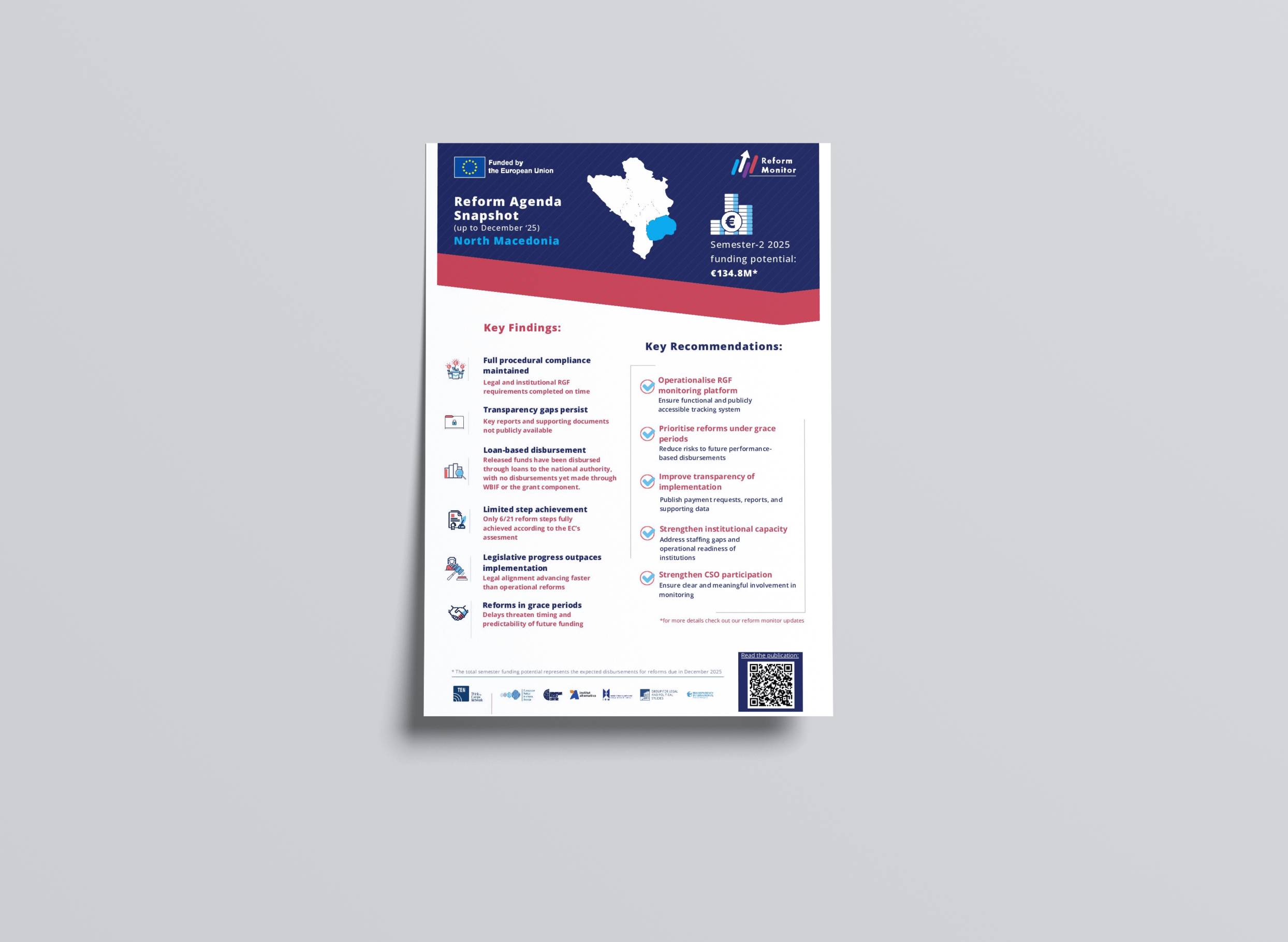
Reform Agenda Snapshot (up to December ‘25) – North Macedonia

Key findings and recommendations from our Reform Monitor update for North Macedonia, up to December 2025.

Snapshot-Macedonia

Download

Северна Македонија – Извештај за спроведувањето на реформската агенда – второ полугодие 2025

Оваа публикација е дел од серијата „Извештаи за спроведувањето на Реформската агенда“ – национални извештаи кои ја следат имплементацијата на реформските агенди како дел од Инструментот за реформи и раст (ИРР) за Западен Балкан, во рамките на проектот „Следење на реформите“.

Оценката на „Извештајот за спроведување на реформската агенда“ се фокусира на напредокот на земјата во спроведувањето на нејзините обврски од ИРР. Следењето се спроведува преку збир на процедурални, реформски и финансиски индикатори. Оваа активност ги следи реформските чекори со утврдени рокови, при што се оценува нивниот степен на исполнување врз основа на јавно достапни докази и официјална документација обезбедена од националните власти, а по потреба надополнета со информации од независни институции и од граѓанското општество. Хоризонтално внимание се посветува на учеството на засегнатите страни и на транспарентноста.

Следењето опфаќа реформи организирани во т.н. „домени на политики“, формирани преку кодирање на подрачјата во рамките на усогласените области на политики во Реформските агенди. Избраните политички домени, кои овозможуваат анализи на регионално ниво, вредносно оценување и меѓусебна споредливост, се потпираат на човечките ресурси и тематската експертиза на мрежата TEN.

За методолошките белешки и процесот на селекција на реформските чекори видете ja нацрт-методолошката белешкa на следниот линк.

Извештајот за спроведувањето на Реформската агенда е структуриран на следниов начин: „Клучните наоди и препораки“ нудат сумиран преглед на главните заклучоци, додека поглавјата „Правни и институционални аранжмани“ и „Барања и одобрување на средства“ го следат вкупниот напредок во процедуралните и финансиските аспекти на спроведувањето. Последниот дел, „Реформи во фокус: домени на политики во рамките на следењето на реформите“, ги презентира независните наоди од следењето на избраните реформи. Во секој од овие делови е содржан наративен преглед на напредокот и на предизвиците при имплементацијата на Реформската агенда.

Пресечниот рок за прибирање и проценка на податоците за овој извештај е 31.12.2025 година. Понатамошниот развој на политиките може да го смени статусот на реформите што во моментов се во тек и тоа ќе биде дел од следните извештаи.

Извештаите од следењето не претставуваат замена за формалната оценка од страна на Европската комисија.

RA_Update-Reform-Monitor_2nd-Semester-2025_North-Macedonia_mk

North Macedonia – Reform Agenda Update – 2nd Semester 2025

This publication is part of the series “Reform Agenda Updates”, national monitoring reports that track the implementation of the Reform Agendas as part of the Reform and Growth Facility for the Western Balkans, within the Reform Monitor project.

The “Reform Agenda Updates” assessment focuses on the implementation progress of country-specific obligations under the RGF. Monitoring is conducted through a set of procedural, reform implementation, and financial indicators. The core of the monitoring exercise tracks reform steps with defined deadlines, assessing their implementation status based on publicly available evidence and official documentation obtained by national authorities, and, where relevant, complemented by information from independent institutions and civil society sources. Cross-cutting attention is given to stakeholder participation and transparency.

The monitoring exercise covers selected reforms organised into so-called “policy domains,” created by coding the sub-areas of the harmonised policy areas in the Reform Agendas. The selected policy domains, which enable regional-level analyses, benchmarking, and comparability, are supported by the available human resources and the thematic expertise of the TEN network.  

For methodological notes and the reform steps selection process, see the draft methodology note at the link

The Reform Agenda Update is structured as follows. The Key findings and recommendations provide a high-level summary. The Legal and Institutional Arrangements and Requests and Release of Funds sections monitor overall progress in the procedural and financial aspects of implementing the Reform Agenda. The last section, Reforms in Focus: Reform Monitor policy domains, provides independent monitoring findings on selected reforms. Here, each section provides a narrative snapshot of progress and obstacles in implementing Serbia’s Reform Agenda.

The cut-off date for data collection and assessment for this update is 31.12.2025. Further policy developments may shift the status of currently pending reforms and will be reflected in subsequent updates.

These monitoring updates are not a substitute for the European Commission’s formal assessment role.

RA_Update-Reform-Monitor_2nd-Semester-2025_North-Macedonia

Download

Re-form for Growth: Small Grant Facility

MK | BCMS | SQ

The project “WB Reform and Growth Monitor”, implemented by members of the Think for Europe Network (TEN) and Transparency International in Bosnia and Herzegovina (TI BiH), supported by the European Union, announces a Call for Proposals for the ”Re-form for Growth” Small Grant Facility (SGF).

The objective of this Call is to empower civil society organisations to provide independent monitoring, advocacy, and sector-specific perspectives on the implementation of the Growth Plan for the Western Balkans (GPWB).

A total amount of EUR 314,620 is allocated to the SGF to support up to 20 grants, with an implementation period of 10 to 12 months per action. The financial framework for the grants is as follows:

  • Maximum Grant Amount: EUR 16,000
  • Indicative Average Grant: EUR 15,730

The indicative regional distribution is planned as follows:

CountryNumber of Grants
Serbia4
Bosnia and Herzegovina4
North Macedonia3
Albania     3
Kosovo     3
Montenegro3
TOTAL20

In order to be eligible for a grant, the applicant must:

  • Be a legal entity;
  • Be non-profit making;
  • Be a civil society organisation whose activities are implemented at national and/or local level (i.e. within one or more local self-government units);
  • Demonstrate active engagement and relevant experience in one or more thematic areas relevant to this Call for Proposals, through its mandate, previous or ongoing activities, research, monitoring or advocacy work;
  • Be registered in one of the following countries: North Macedonia, Serbia, Montenegro, Albania, Bosnia and Herzegovina, or Kosovo, at least six (6) months prior to the publication of this Call for Proposals;
  • Be directly responsible for the preparation and management of the action, and not acting as an intermediary;
  • Have sufficient operational and financial capacity to carry out the proposed action;
  • Not be a beneficiary of funding under the EU Civil Society Facility (CSF) and Media Programme (Reference No. EuropeAid/179703/DH/ACT/Multi) for the same implementation period of the proposed action.

Thematic Priorities of the SGF: 

  1. Integration with the EU Single Market;
  2. Regional integration through the Common Regional Market;
  3. Priority Areas of the Reform Agendas;
  4. Implementation of the Reform and Growth Facility;

For more details about this call, please read carefully the GUIDELINES FOR APPLICANTS.

Submission and Deadline

Applications must be submitted electronically with the following completed documents, that can be downloaded from:

Submission Deadline: 06.05.2026

Applications shall be sent to: [email protected]; cc: [email protected] with the subject: “CfP: Re-form for Growth – (Country)_Application”.

The sublimated answers and clarifications to all the recieved questions regarding the call are avalaible at:

Reforma za rast: Program malih grantova

Projekat “WB Reform and Growth Monitor”, koji sprovode članovi mreže Think for Europe Network (TEN) i Transparency International BiH u Bosni i Hercegovini, uz podršku Evropske unije, objavljuje Poziv za dostavljanje predloga za „Re-form for Growth“ program malih grantova (PMG).

Cilj ovog Poziva je osnažiti organizacije civilnog društva da pruže nezavisno praćenje, zagovaranje i sektorski specifične perspektive u vezi sa implementacijom Plana rasta za Zapadni Balkan (GPWB).

Ukupno je za PMG predviđeno 314.620 EUR za podršku do 20 grantova, sa periodom implementacije od 10 do 12 meseci po akciji. Finansijski okvir za grantove je sledeći:

  • Maksimalni iznos granta: 16.000 EUR
  • Indikativni prosečni grant: 15.730 EUR

Indikativna regionalna raspodela je planirana na sledeći način:

DržavaBroj grantova
Srbija4
Bosna i Hercegovina4
Severna Makedonija3
Albanija   3
Kosovo   3
Crna Gora3
UKUPNO20

Da bi bio/la podoban/a za dobijanje granta, podnosilac prijave mora:

  • Biti pravno lice;
  • Biti neprofitna organizacija;
  • Biti organizacija civilnog društva čije se aktivnosti sprovode na nacionalnom i/ili lokalnom nivou (tj. u okviru jedne ili više jedinica lokalne samouprave);
  • Pokazati aktivno angažovanje i relevantno iskustvo u jednoj ili više tematskih oblasti relevantnih za ovaj Poziv za dostavljanje predloga, kroz svoj mandat, prethodne ili tekuće aktivnosti, istraživanja, praćenje ili zagovarački rad;
  • Biti registrovan/a u jednoj od sledećih zemalja: Severna Makedonija, Srbija, Crna Gora, Albanija, Bosna i Hercegovina ili Kosovo, najmanje šest (6) meseci pre objavljivanja ovog Poziva;
  • Biti direktno odgovoran/a za pripremu i upravljanje akcijom, a ne delovati kao posrednik;
  • Imati dovoljnu operativnu i finansijsku sposobnost za sprovođenje predložene akcije;Ne sme biti korisnik finansiranja u okviru EU Programa za civilno društvo i medije (CSF) (Referentni broj EuropeAid/179703/DH/ACT/Multi) za isti period implementacije predložene akcije.

Tematski prioriteti Poziva: 

  1. Integracija sa Jedinstvenim tržištem EU;
  2. Regionalna integracija kroz Zajedničko regionalno tržište;
  3. Prioritetne oblasti reformskih agendi;
  4. Primena Instrumenta za reformu i rast;

Za više detalja o ovom pozivu, pažljivo pročitajte SMERNICE ZA PODNOSIOCE PRIJAVA.

Podnošenje prijava i rok

Prijave moraju biti podnete elektronski sa sledećim popunjenim dokumentima:

Rok za podnošenje: 6. maj

Prijave se šalju na: [email protected]; cc: [email protected] sa predmetom: “CfP: Re-form for Growth – (Country)_Application”.

Po potrebi, dodatne informacije mogu se dobiti slanjem pitanja na navedene e-mail adrese, najkasnije do 6. aprila 2026.