

Bosnia and Herzegovina faces the risk of permanently losing 373.9 of the total 976.6 million euros available to it through the Growth Plan for the Western Balkans if it does not implement reforms in the areas of strengthening the , judicial integrity, preventing conflicts of interest, and protecting whistleblowers by the end of the year, as it committed to under the Reform Agenda.
While warnings from the EU indicate that deadlines will no longer be extended, BiH has already been sanctioned with a 10% reduction in available funds due to delays, meaning that 108 million euros will be invested elsewhere instead of in development and infrastructure projects in BiH, and further procrastination means not only the loss of nearly one billion marks, but also further erosion of credibility on the European path.
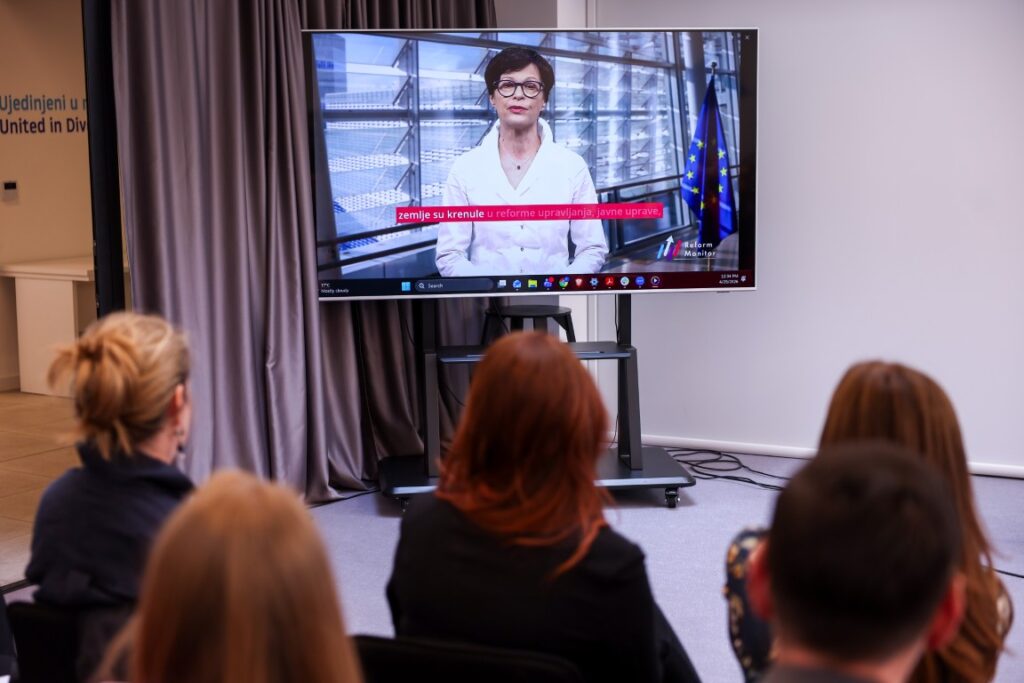
“Just last week, I sent a letter to the authorities, warning that Bosnia and Herzegovina risks losing hundreds of millions of euros if the necessary reforms are not implemented by December 2026. years” emphasized Marta Kos, European Commissioner for Enlargement, in a at the opening of the First Consultative Forum on the Implementation of the Reform Agenda in BiH (CONFRA BiH), organized today in Sarajevo by International in Bosnia and Herzegovina (TI BiH).
She added that there will be no extension of this deadline, warning that “almost 50 percent of the funds (977 million convertible marks) could be lost” and reminded that countries in the region have launched necessary reforms in governance, public administration, the private sector, energy, human capital, and the rule of law, after which the promised funds followed.
Unlike them, Bosnia and Herzegovina, where public focus has been too long on the amount of available funds rather than on the obligations that must be fulfilled, has still not signed and ratified the agreement on accession to the Reform and Growth Instrument and the loan agreement, which are prerequisites for using the 976.6 million euros.

However, inaction also carries its own cost. Namely, in the absence of reforms, Bosnia and Herzegovina risks losing 373 million euros from the funds allocated under the Growth Plan, in addition to the 108 million euros it lost last year.
“The reforms in the Reform Agenda are the blueprint for an economic transformation in this country – one that will help it to use its considerable economic potential. This country has an educated population, a proud industrial tradition and is geographically located in the heart of Europe close to the European Single Market.” stated Luigi Soreca, Head of the EU Delegation to Bosnia and Herzegovina, adding that these advantages are not being utilized sufficiently.
“The education system needs urgent reform. Much of BiH’s industry relies on ageing technology, and needs to be modernised, including to take advantage of the clean energy revolution. BiH may be geographically close to the European Single Market, but barriers still exist to accessing it. The reforms in the Reform Agenda help bring these barriers down and move this country closer to receiving the benefits of EU membership. There is however also a cost to inaction – in the absence of reforms, regrettably, Bosnia and Herzegovina is at risk of losing EUR 373 million from its allocation under the Growth Plan, in addition to the EUR 108 million it lost last year” Soreca added.
Forum participants emphasized that the aforementioned funds from the Growth Plan are not a reward for declarative commitment to the European path, but support for countries that demonstrate , capacity, and responsibility to implement reforms. Therefore, BiH must appoint a national coordinator, establish a secretariat, a monitoring committee, and contact points for each reform step, so that it is clear who is responsible for implementation, monitoring, and reporting.
In addition, it was emphasized, the implementation process must be more open to the public, which means that the authorities must publish the Reform Agenda in the official languages of BiH together with a list of infrastructure projects to be financed from the Growth Plan, so that citizens know what the state has promised and where it plans to direct the available funds.

“The Growth Plan is a test of institutional responsibility, not just a financial opportunity. If the authorities in BiH are not prepared to implement the reforms they themselves undertook, then the problem is not only in the lost funds, but in the message that political representatives are sending to the EU and citizens. The attitude toward the Growth Plan today shows the real attitude toward BiH’s European path “, stated Ivana Korajlić, Executive Director of TI BiH.
TI BiH warns that when establishing the institutional framework, lessons learned from a decade of a dysfunctional coordination mechanism must be utilized. Through the new system, it is necessary to define clear responsibilities, deadlines, and mechanisms for overcoming blockages, so that the implementation of the Reform Agenda does not turn into another captured process.
and other relevant actors need to be included in the work of the monitoring committee through a transparent process and clear criteria, based on expertise, experience, and proven results. Only in this way can the monitoring and reporting process be of higher quality, more open, and focused on real results.
Continued delays and political blockages do not only mean the loss of available funds. They directly harm BiH’s credibility before the European Union and member states, and reduce the chances that the country will make a serious step forward toward opening negotiations in the near future. Therefore, TI BiH calls on the authorities to open the implementation process of the Reform Agenda to civil society and to use CONFRA BiH as a space for regular dialogue, monitoring progress, and addressing obstacles in fulfilling undertaken obligations.
![[Поткаст со министерот Андоновски] Како се гради дигитална иднина со помош на Реформската агенда?](https://reform-monitor.org/wp-content/uploads/2026/04/podcast-stefan-andonovski2.png)








.jpg)