Bosnia and Herzegovina’s Reform Agenda: Between Political Deadlock and EU Conditionality

Bosnia and Herzegovina’s (BiH) Reform Agenda (RA) is the strategic framework prepared under the European Commission’s Growth Plan for the Western Balkans (Growth Plan) and the Reform and Growth Facility (RGF), which is designed to link financial support to the delivery of measurable reforms. The RA provides BiH with an opportunity to demonstrate both political commitment and administrative capacity to deliver reforms aligned with EU standards, while also strengthening the institutional functionality needed for accession negotiations.

BiH submitted its RA with a one-year delay and entered 2026 without the key preconditions for disbursements in place, including signature and ratification of the Facility Agreement and the Loan Agreement, as well as the establishment of domestic implementation and reporting structures.

The RA is organised around four policy areas and translates priorities into 26 reforms, 113 reform steps, and 372 activities. These are grouped under Green and Digital Transition, Private Sector Development and Business Environment, Human Capital Development, and Fundamentals. While the Agenda spans economic governance, the business environment, human capital, and the green and digital transition, the fundamentals are central for accession credibility, particularly in areas assessed under Chapters 23 and 24, where enforcement, institutional independence, and track record are decisive, and where successive European Commission reports have for years pointed to limited progress and persistent shortcomings.

This policy update is structured in three parts. First, it analyses the development and adoption process in the national context, including the drivers of blockage, the role of contested reforms, non-executive involvement, consultations, and public communication around the Facility. Second, it provides an overview of the RA’s key policy areas and the main delivery risks embedded in them. Third, it examines the institutional setup envisaged for implementation under the RGF, with particular attention to governance design risks, coordination challenges, and the conditions for functional monitoring and reporting.

Beyond its role as a gateway to RGF funding, the RA is also a test of BiH’s ability to coordinate across jurisdictions, manage political disagreement through workable procedures, and deliver measurable results under EU timelines. The extent to which BiH can translate the RA into functioning implementation structures and credible delivery will shape both access to funds and the country’s broader accession credibility.

Reform-Monitor_Bosnia-and-Herzegovinas
Download

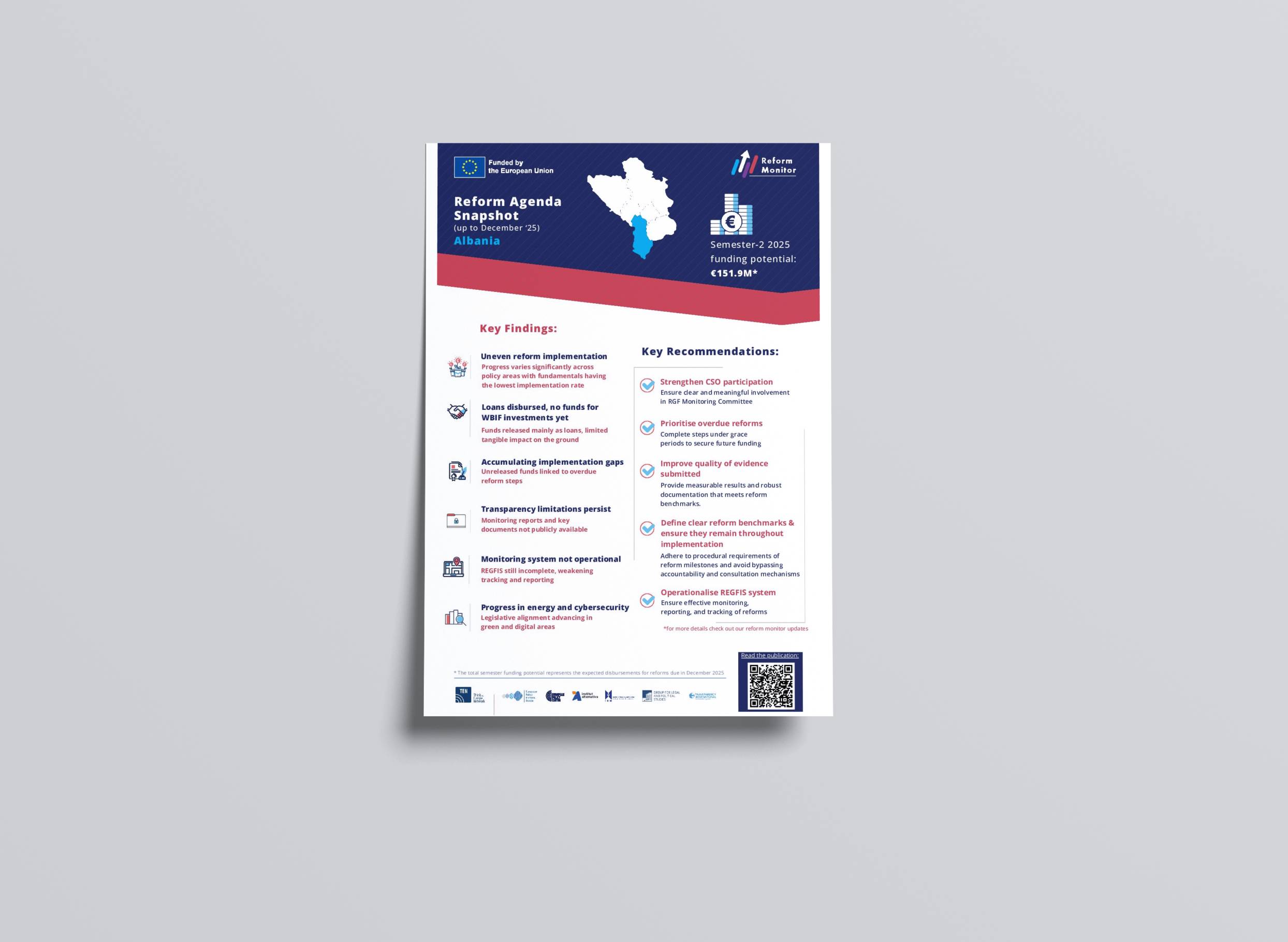
Reform Agenda Snapshot (up to December ‘25) – Albania

Key findings and recommendations from our Reform Monitor update for Albania, up to December 2025.

Snapshot-Albania

Download

Albania – Reform Agenda Update – 2nd Semester 2025

This publication is part of the series “Reform Agenda Updates”, national monitoring reports that track the implementation of the Reform Agendas as part of the Reform and Growth Facility for the Western Balkans, within the Reform Monitor project.

The “Reform Agenda Updates” assessment focuses on the implementation progress of country-specific obligations under the RGF. Monitoring is conducted through a set of procedural, reform implementation, and financial indicators. The core of the monitoring exercise tracks reform steps with defined deadlines, assessing their implementation status based on publicly available evidence and official documentation obtained by national authorities, and, where relevant, complemented by information from independent institutions and civil society sources. Cross-cutting attention is given to stakeholder participation and transparency.

The monitoring exercise covers selected reforms organised into so-called “policy domains,” created by coding the sub-areas of the harmonised policy areas in the Reform Agendas. The selected policy domains, which enable regional-level analyses, benchmarking, and comparability, are supported by the available human resources and the thematic expertise of the TEN network.  

For methodological notes and the reform steps selection process, see the draft methodology note at the link. 

The Reform Agenda Update is structured as follows. The Key findings and recommendations provide a high-level summary. The Legal and Institutional Arrangements and Requests and Release of Funds sections monitor overall progress in the procedural and financial aspects of implementing the Reform Agenda. The last section, Reforms in Focus: Reform Monitor policy domains, provides independent monitoring findings on selected reforms. Here, each section provides a narrative snapshot of progress and obstacles in implementing Albania’s Reform Agenda.

The cut-off date for data collection and assessment for this update is 31.12.2025. Further policy developments may shift the status of currently pending reforms and will be reflected in subsequent updates.

These monitoring updates are not a substitute for the European Commission’s formal assessment role.

RA_Update_Reform-Monitor_2nd-Semester-2025_Albania

Download

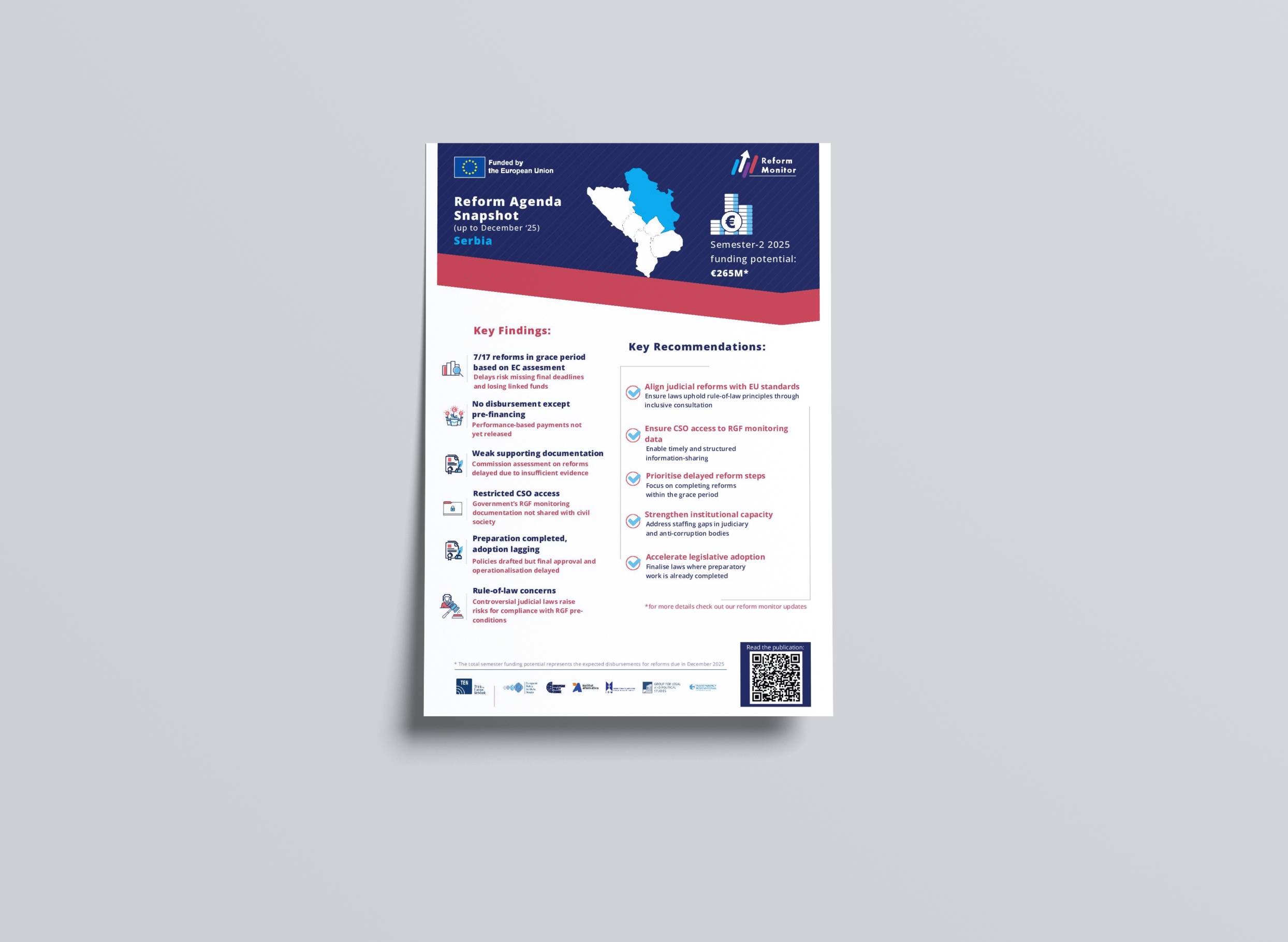
Reform Agenda Snapshot (up to December ‘25) – Serbia

Key findings and recommendations from our Reform Monitor update for Serbia, up to December 2025.

Snapshot-Serbia

Download

Serbia – Reform Agenda Update – 2nd Semester 2025

This publication is part of the series “Reform Agenda Updates”, national monitoring reports that track the implementation of the Reform Agendas as part of the Reform and Growth Facility for the Western Balkans, within the Reform Monitor project.

The “Reform Agenda Updates” assessment focuses on the implementation progress of country-specific obligations under the RGF. Monitoring is conducted through a set of procedural, reform implementation, and financial indicators. The core of the monitoring exercise tracks reform steps with defined deadlines, assessing their implementation status based on publicly available evidence and official documentation obtained by national authorities, and, where relevant, complemented by information from independent institutions and civil society sources. Cross-cutting attention is given to stakeholder participation and transparency.

The monitoring exercise covers selected reforms organised into so-called “policy domains,” created by coding the sub-areas of the harmonised policy areas in the Reform Agendas. The selected policy domains, which enable regional-level analyses, benchmarking, and comparability, are supported by the available human resources and the thematic expertise of the TEN network.  

For methodological notes and the reform steps selection process, see the draft methodology note at the link. 

The Reform Agenda Update is structured as follows. The Key findings and recommendations provide a high-level summary. The Legal and Institutional Arrangements and Requests and Release of Funds sections monitor overall progress in the procedural and financial aspects of implementing the Reform Agenda. The last section, Reforms in Focus: Reform Monitor policy domains, provides independent monitoring findings on selected reforms. Here, each section provides a narrative snapshot of progress and obstacles in implementing Serbia’s Reform Agenda.

The cut-off date for data collection and assessment for this update is 31.12.2025. Further policy developments may shift the status of currently pending reforms and will be reflected in subsequent updates.

These monitoring updates are not a substitute for the European Commission’s formal assessment role.

RA_Update-Reform-Monitor_2nd-Semester-2025-1

Download

Ažuriranо praćenje Reformske agende Srbije – Monitor reformi – 2. semestar 2025. godine

Ova publikacija je deo serije “Ažuriranog praćenja Reformskih agendi”, nacionalnih izveštaja o monitoringu koji prate sprovođenje reformskih programa u okviru Instrumenta za reforme i rast za Zapadni Balkan (RGF – Reform and Growth Facility), kao deo projekta Reform Monitor.

Procena „Ažuriranog praćenja reformske agende” fokusira se na napredak u ispunjavanju obaveza u okviru RGF-a za svaku od pojedinačnih zemalja. Monitoring se vrši kroz skup proceduralnih, reformskih i finansijskih pokazatelja. Srž aktivnosti monitoringa prati reformske korake sa definisanim rokovima, procenjujući njihov nivo ispunjenosti na osnovu javno dostupnih podataka i zvanične dokumentacije dobijene od strane državnih vlasti i, po potrebi, dopunjene informacijama iz nezavisnih institucija i izvora civilnog društva. Kroz sve reformske korake, posebna pažnja se posvećuje učešću zainteresovanih strana i transparentnosti.

Aktivnost praćenja obuhvata odabrane reforme organizovane u takozvane „domene politika“, nastale kodiranjem podoblasti u okviru harmonizovanih oblasti politika definisanim u Reformskim agendama. Pri odabiru domena politika, koji omogućavaju analize na regionalnom nivou, postavljanje merila (benchmarking) i uporedivost, vodilo se računa o raspoloživim ljudskim resursima i tematskom ekspertizom mreže TEN.  

Za metodološke napomene i proces odabira reformskih koraka, pogledajte nacrt metodologije na linku. 

Ažurirano praćenje Reformske agende strukturisano je na sledeći način. Ključni nalazi i preporuke pružaju skraćeni pregled. Odeljci „Pravni i institucionalni aranžmani i zahtevi i isplata sredstava” prate ukupan napredak u proceduralnim i finansijskim aspektima sprovođenja Reformske agende. Poslednji odeljak, „Reforme u fokusu: Reformski monitor domena politika“ pruža nezavisne nalaze praćenja po odabranim reformama. Ovde svaki deo daje narativni prikaz napretka i prepreka u sprovođenju Reformske agende Srbije.

Krajnji datum za prikupljanje i procenu podataka za ovo ažuriranje je 31. 12. 2025. godine. Dalji razvoj politika može promeniti status reformi koje su trenutno u toku i to će se odraziti na naredna ažuriranja.

Ova ažurirana praćenja nisu zamena za formalnu ulogu Evropske komisije.

RA_Pilot-Reform-Monitor_2nd-Semester-2025_Republike-Srbije

Download

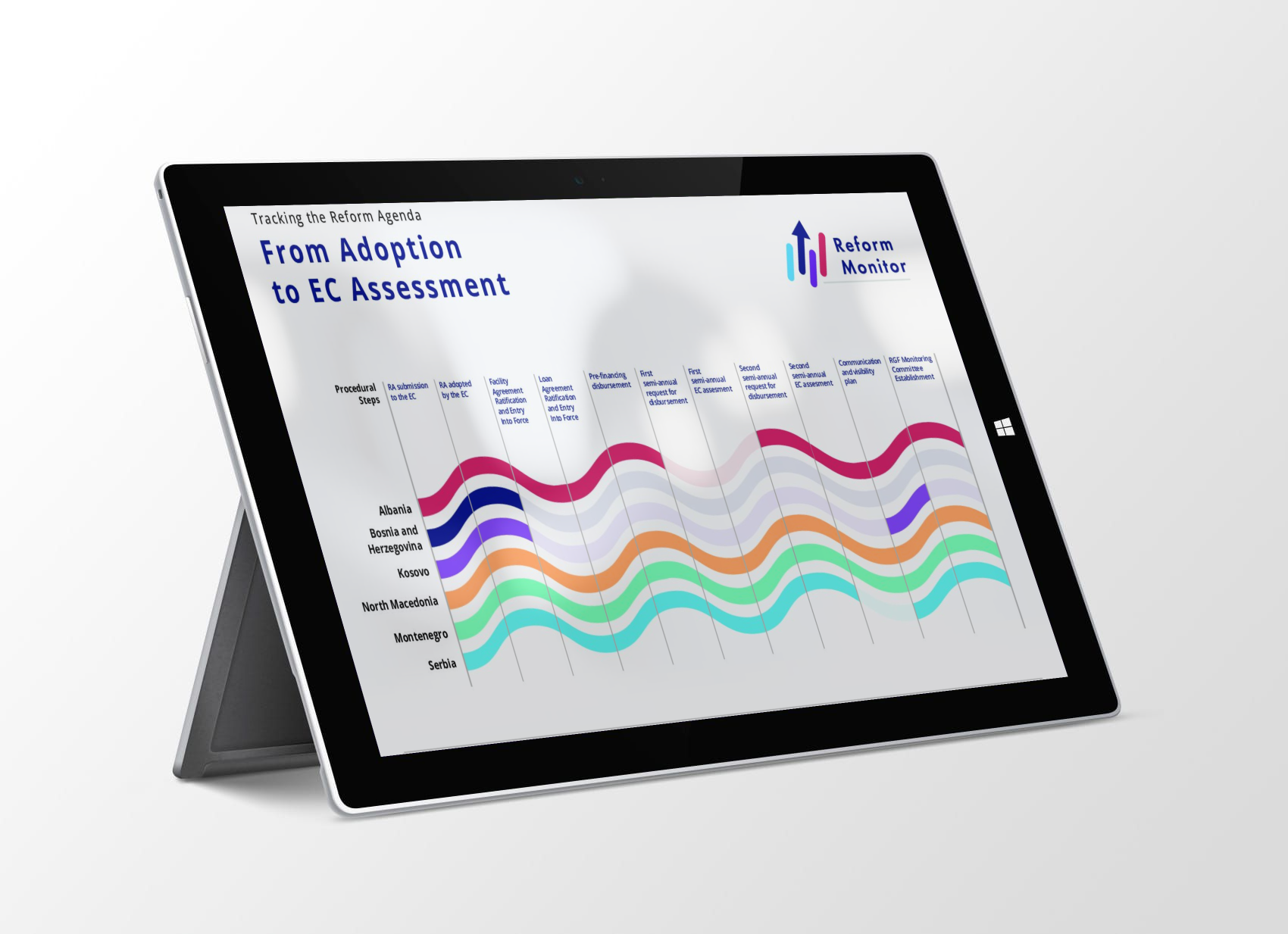
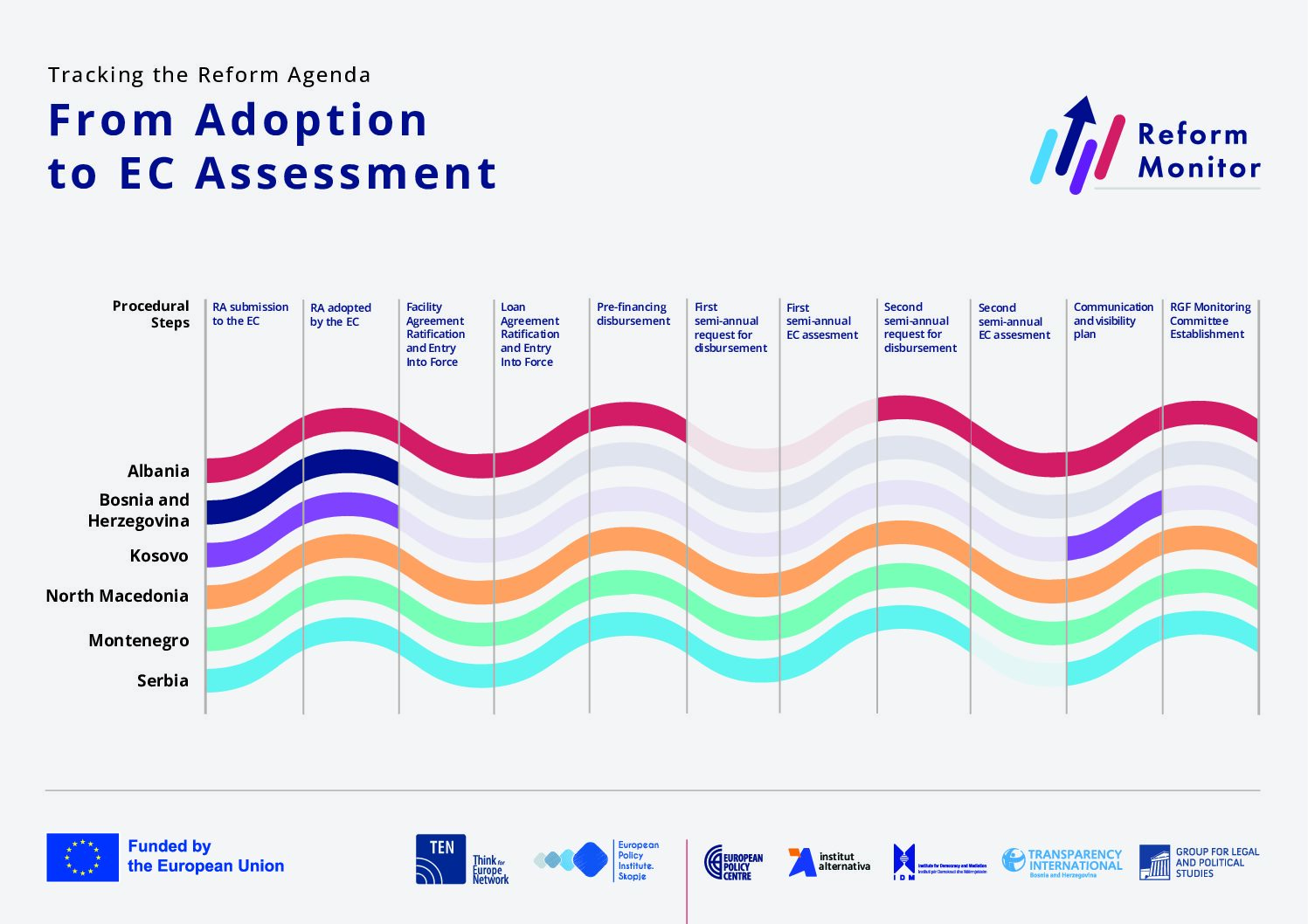
Tracking the Reform Agenda – January 2026 – From Adoption to EC Assessment

The infographic “Tracking the Reform Agenda: From Adoption to EC Assessment” provides a clear and concise visual overview of the key stages in the reform process, from the initial adoption of policies to their evaluation by the European Commission. Designed to enhance understanding of this complex journey, it highlights critical milestones.

Proposed Methodology for Measuring Reform Agendas’ Progress in Western Balkan Countries

The Reform and Growth Facility (RGF) for the Western Balkans is a new €6 billion instrument (2024–2027) that links EU financial assistance to the implementation of ambitious Reform Agendas in each Western Balkan country. These Reform Agendas outline socio-economic and fundamental reforms aimed at spurring growth and convergence with the EU, focusing on priority areas such as Rule of Law and Fundamental Rights, Green Transition and Digital Transformation, Business Environment and Private Sector Development, and Human Capital. In exchange for undertaking these reforms, partner governments receive budget support disbursements upon completion of agreed reform steps. This report presents a methodological framework for monitoring the Reform Agendas under the RGF, structured as a formal methodology document. It covers two key tasks: (1) preparatory consultations to define the monitoring approach and align it with best EU and international practices, and (2) development of a draft monitoring methodology including indicators, data collection tools, reporting templates, and analytical frameworks (with regional and gender perspectives). The report includes an overview of relevant best practices, a detailed monitoring framework proposal, and recommendations for implementation, with references to EU, World Bank, and IMF approaches that inform the methodology.

Proposed-Methodology-for-Measuring-Reform-Agendas-Progress-in-Western-Balkan-Countries-1
Download

Tracking the Reform Agenda – October 2025 – From Adoption to EC Assessment

The infographic “Tracking the Reform Agenda: From Adoption to EC Assessment” provides a clear and concise visual overview of the key stages in the reform process, from the initial adoption of policies to their evaluation by the European Commission. Designed to enhance understanding of this complex journey, it highlights critical milestones.

Albania – Reform Agenda Snapshot: INSIGHTS FROM THE EUROPEAN COMMISSION’S FIRST ASSESSMENT

On October 16, 2025, the European Commission published its assessment of Albania’s Reform Agenda implementation, offering the first detailed look into the country’s progress. The assessment covered two reporting periods, December 2024 and June 2025, and the results paint a complex picture of a country making strides in some areas while struggling in others.

The headline numbers tell a story of partial success.

IDM-Brief-Reform-Agenda-Snapshot

Download