First Plenary Session of Serbia’s Intersectoral Working Group Under WB Reform and Growth Monitor Project Advances EU Reform Monitoring

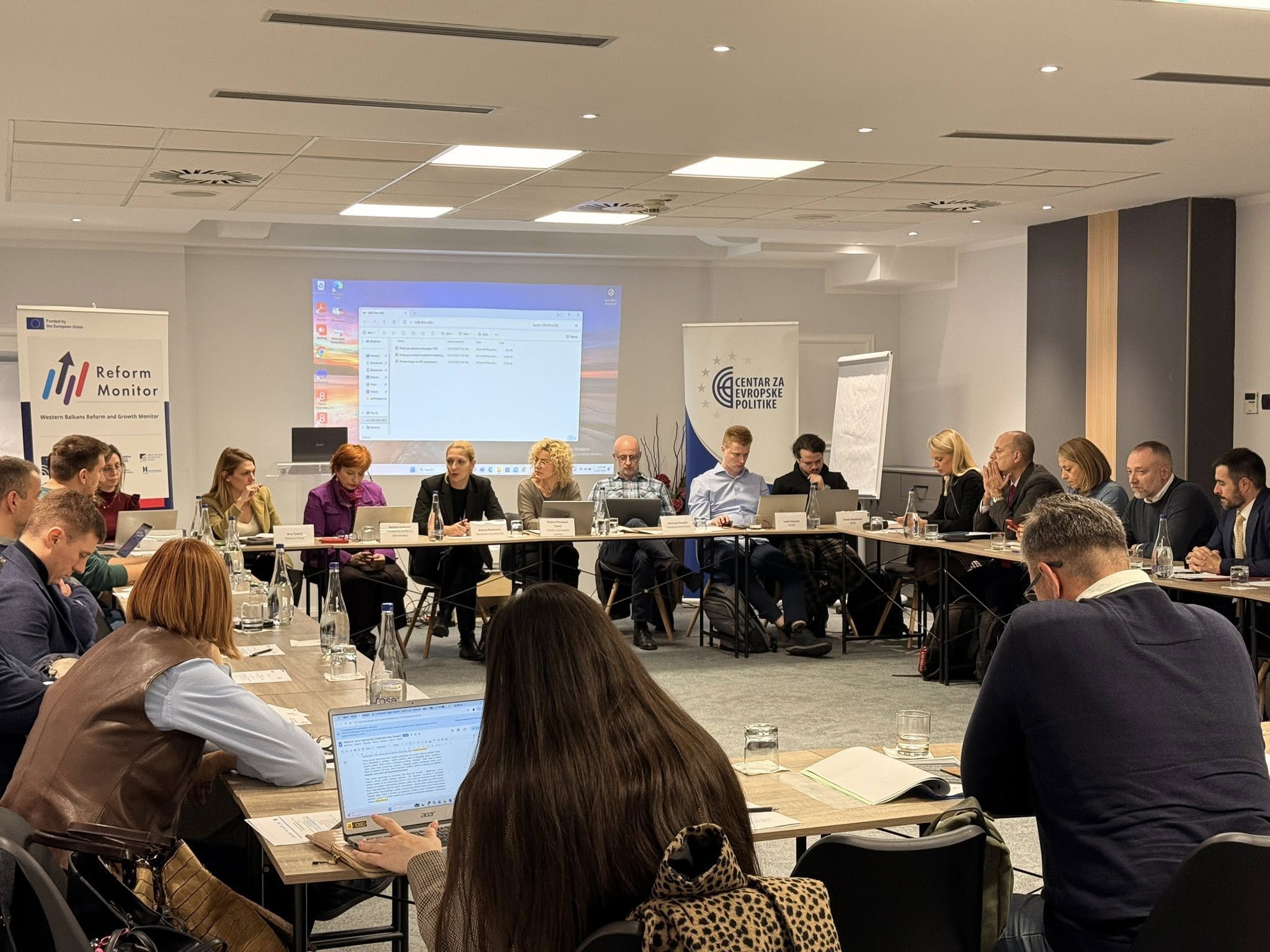
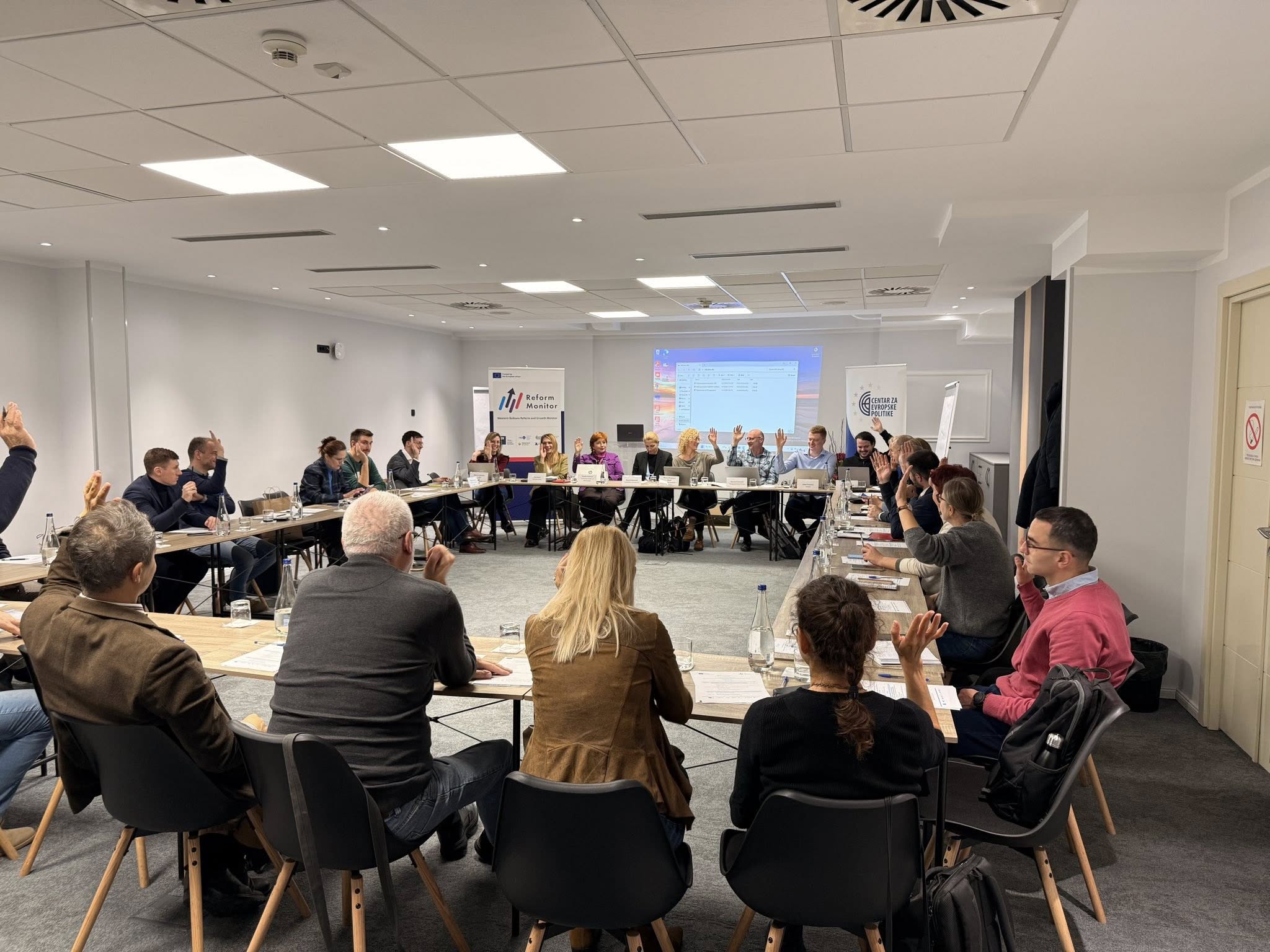
Yesterday, the first plenary session of the Intersectoral Working Group for Monitoring the Implementation of the Reform Agenda of the Republic of Serbia was held, organised by the National Convention on the EU (NCEU) and the European Policy Centre (CEP) within the framework of the WB Reform and Growth Monitor project.

This platform was established to ensure the active participation of civil society in the implementation and monitoring of Serbia’s Reform Agenda, through tracking progress on reform steps, providing analytical support and external monitoring, as well as assessing their impact on European integration and informing the public about the results.

In its work, the IWG will cooperate closely with representatives of the European Union and state institutions to ensure effective oversight of the implementation of this important strategic document, which is linked to EU support amounting to EUR 1.6 billion by the end of 2027.

During yesterday’s session, the IWG adopted its Rules of Procedure, while subgroup coordinators presented their areas of work and upcoming plans. The discussion focused on the report from the first meeting of the Reform and Growth Facility (RGF) Monitoring Committee.

This platform represents an important step toward strengthening the contribution of civil society, academia, and the private sector to the reform implementation process in Serbia.

Tracking the Reform Agenda – October 2025 – From Adoption to EC Assessment

The infographic “Tracking the Reform Agenda: From Adoption to EC Assessment” provides a clear and concise visual overview of the key stages in the reform process, from the initial adoption of policies to their evaluation by the European Commission. Designed to enhance understanding of this complex journey, it highlights critical milestones.

Albania – Reform Agenda Snapshot: INSIGHTS FROM THE EUROPEAN COMMISSION’S FIRST ASSESSMENT

On October 16, 2025, the European Commission published its assessment of Albania’s Reform Agenda implementation, offering the first detailed look into the country’s progress. The assessment covered two reporting periods, December 2024 and June 2025, and the results paint a complex picture of a country making strides in some areas while struggling in others.

The headline numbers tell a story of partial success.

IDM-Brief-Reform-Agenda-Snapshot

Download

North Macedonia – INSIGHTS FROM THE EC’S ASSESSMENTS IN JULY AND OCTOBER 2025

On 30 July and 8 October 2025, the European Commission published its assessments of North Macedonia’s implementation of the Reform Agenda for the reform steps scheduled for December 2024 and June 2025. The assessments provide an in-depth overview of the country’s performance, highlighting key areas of progress, delays and remaining gaps across priority areas. The headline figures point to a limited level of success. Of the 21 reform steps that North Macedonia committed to complete across the two reporting periods (December 2024 and June 2025), it implemented 6 reform steps, corresponding to a completion rate of 28,6 %.

Reform-Agenda-insights-from-EC-assessment-North-Macedonia-july-and-october-2025.pdf

Download

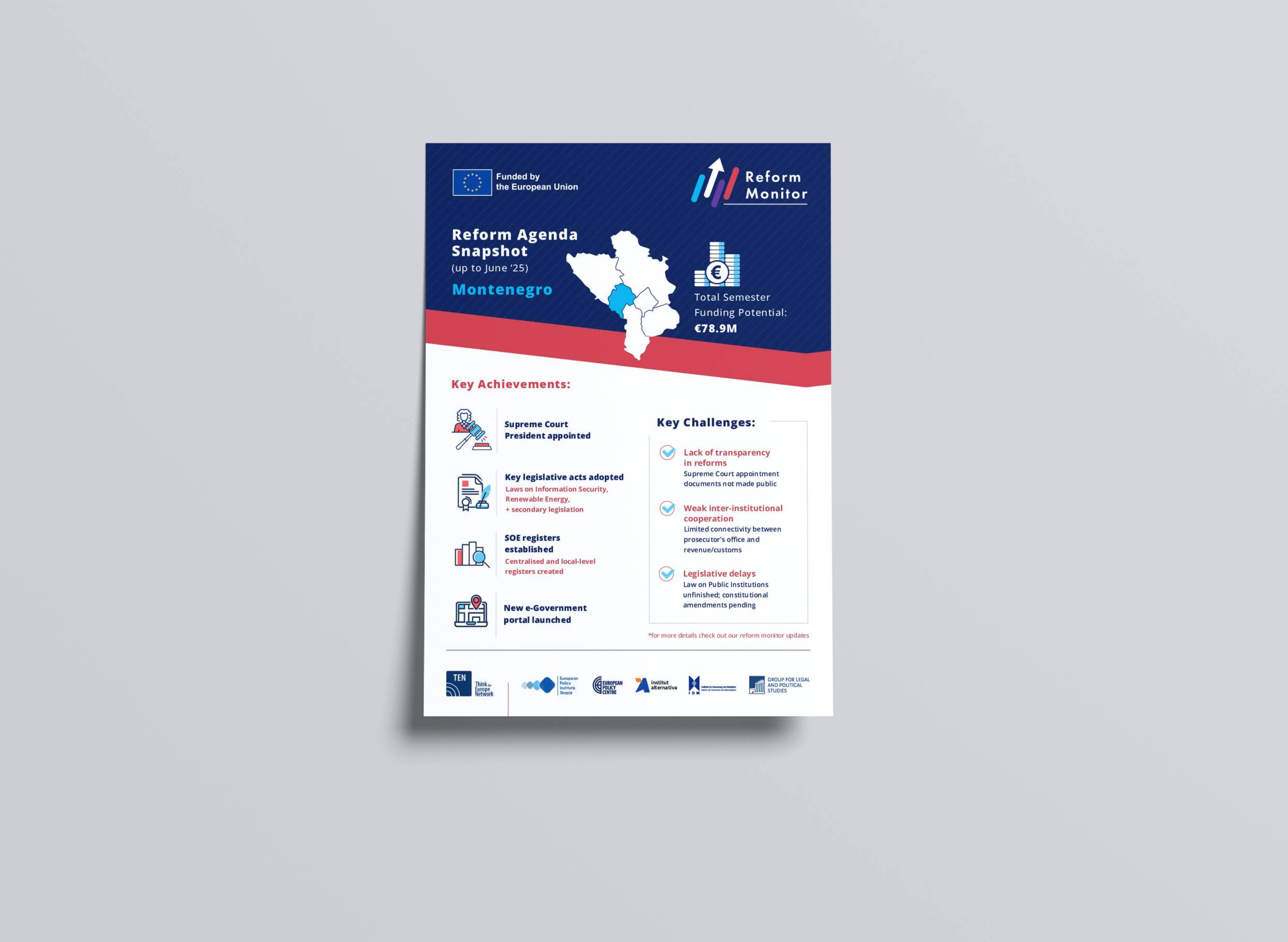
Reform Agenda Snapshot (Јune ‘25) – Montenegro

This infographic provides an overview of Montenegro’s Reform Agenda implementation up to June 2025, highlighting progress made, pending measures, and key challenges across priority areas.

Reform-Agenda-Snapshot-up-to-june-‘25_Montenegro-1

Повик за изразување интерес за приклучување кон Националниот консултативен механизам за Реформската агенда 2024-2027 (НКМ-РА) на Северна Македонија

Институтот за европска политика – Скопје (ЕПИ) како координатор на регионалниот проект „Следење реформи и раст во Западен Балкан“ кој се спроведува во партнерство со партнерите од мрежата „Мисли за Европа“ (Think for Europe Network (TEN)),  ги повикува сите заинтересирани граѓански организации (ГО), стопански комори, социјални партнери, академската заедница и други засегнати чинители во Северна Македонија да го изразат својот интерес за учество во Националниот консултативен механизам за Реформската агенда 2024-2027 (НКМ-РА). 

Што е НКМ–РА? 

НКМ-РА е национална консултативна плаформа што овозможува структуиран, инклузивен дијалог, заснован врз докази помеѓу јавните институции, ГО, стопанските комори, академската заедница, и други засегнати чинители, за спроведувањето и следењето на Реформската агенда 2024-2027 во Северна Македонија во рамки на Инструментот за реформи и раст за Западен Балкан на Европската Унија. 

Платформата е координирана од ЕПИ, а поддржана од Министерството за европски прашања, институцијата која ги координира сите активности поврзани со спроведувањето на Реформската агенда во земјата, врз основа на потпишан Меморандум за соработка со цел да се обезбеди структуриран дијалог и транспарентност, во согласност со нагласокот на Европската комисија за вклучување на граѓанските организации во реформските процеси.  

Кој може да се приклучи во НКМ-РА? 

НКМ-РА е платформа отворена за сите невладини чинители со искуство или интерес за следење на Планот за раст, Реформската агенда и/или процесите на ЕУ интеграцијата. Од учесниците во консултативниот механизам се очекува конструктивен придонес и почитување на принципите на инклузивност, транспарентност и дијалог заснован врз докази.  

Зошто да се приклучите на НКМ–РА?

НКМ–РА обезбедува простор за конструктивна соработка помеѓу државни органи и останати засегнати чинители, овозможувајќи им на членовите да придонесат кон следење засновано на докази и дискусии за реформи, како и да влијаат врз спроведувањето  на Планот за раст за ЗБ . Специфично, платформата ќе:

  • Овозможи консултации засновани на податоци и алатки за следење;
  • Поттикне меѓусекторска соработка помеѓу различни нивоа на владеење;
  • Понуди можност за градење на капацитети и поддршка за застапување;
  • Промовира транспарентност и отчетност преку објавување извештаи од состаноци и повратни информации од засегнати чинители.

Како да се приклучите?

Доколку Вашата организација сака да се приклучи во НКМ-РА, Ве замолуваме да го пополните формуларот достапен на следниот линк: https://forms.gle/mFeqyVHWdUNPsqfD9. *Доколку веќе сте се пријавиле за учество во НКМ-РА не е потребно да го правите истото повторно.

Следни чекори

Првите два состаноци од НКМ-РА се одржаа минатата година, а третиот е закажан за мај.

Montenegro Reform Agenda – Accumulation of Obligations and Unpaid Funds

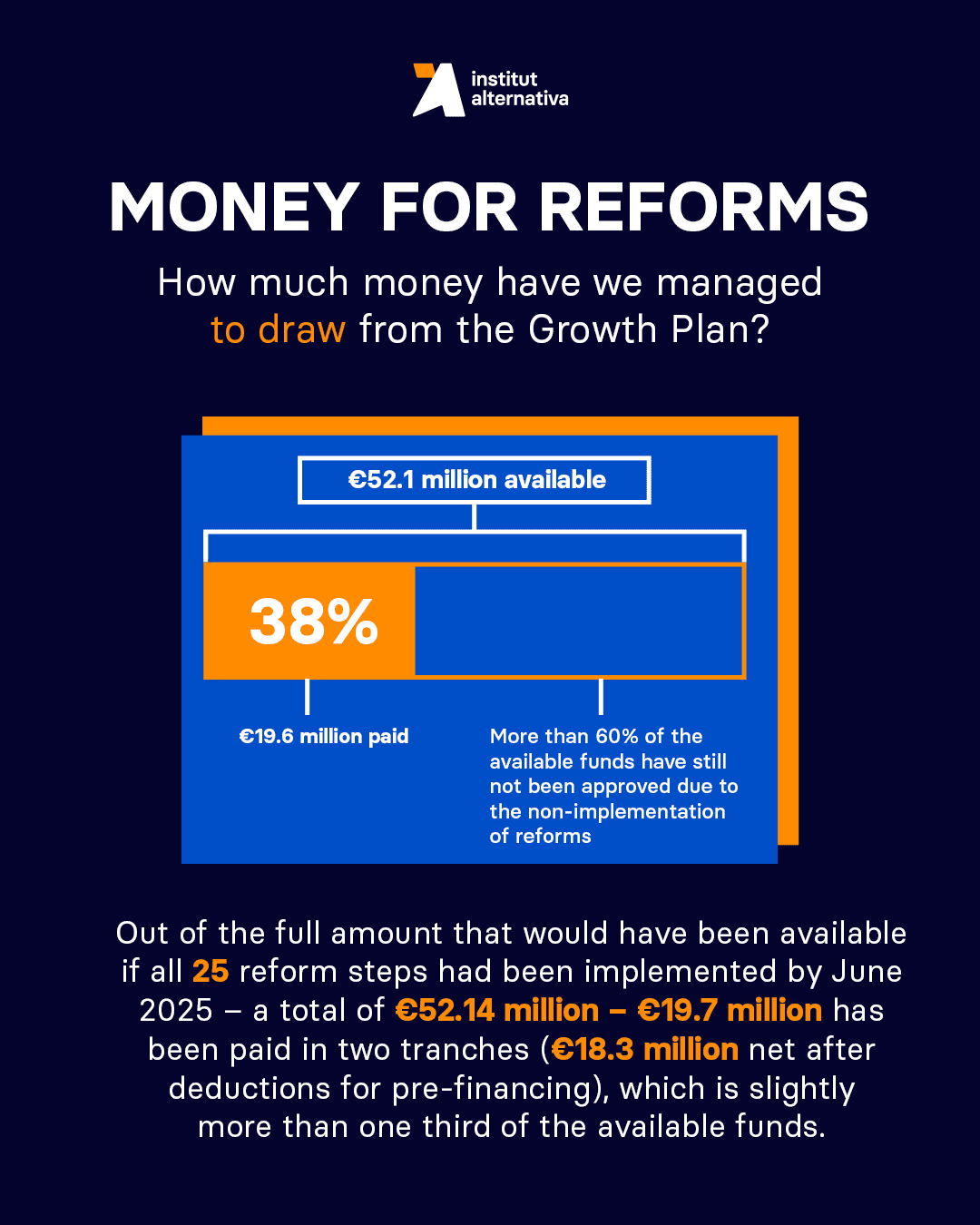
So far, Montenegro has withdrawn just over one third of the funds that were available for the successful implementation of the Reform Agenda. Reports by the European Commission point to unreliable reporting and slow progress in meeting targets, while measures “on hold” continue to accumulate.

Although the disbursement of the first and second tranches of the Reform Agenda has been proclaimed a success by our officials, European Commission reports highlight worrying problems regarding the accuracy of government reporting, the accumulation of unimplemented reform steps, and the fact that we have so far managed to draw only slightly more than one third of the available funds, the payment of which is conditional on the implementation of reforms.

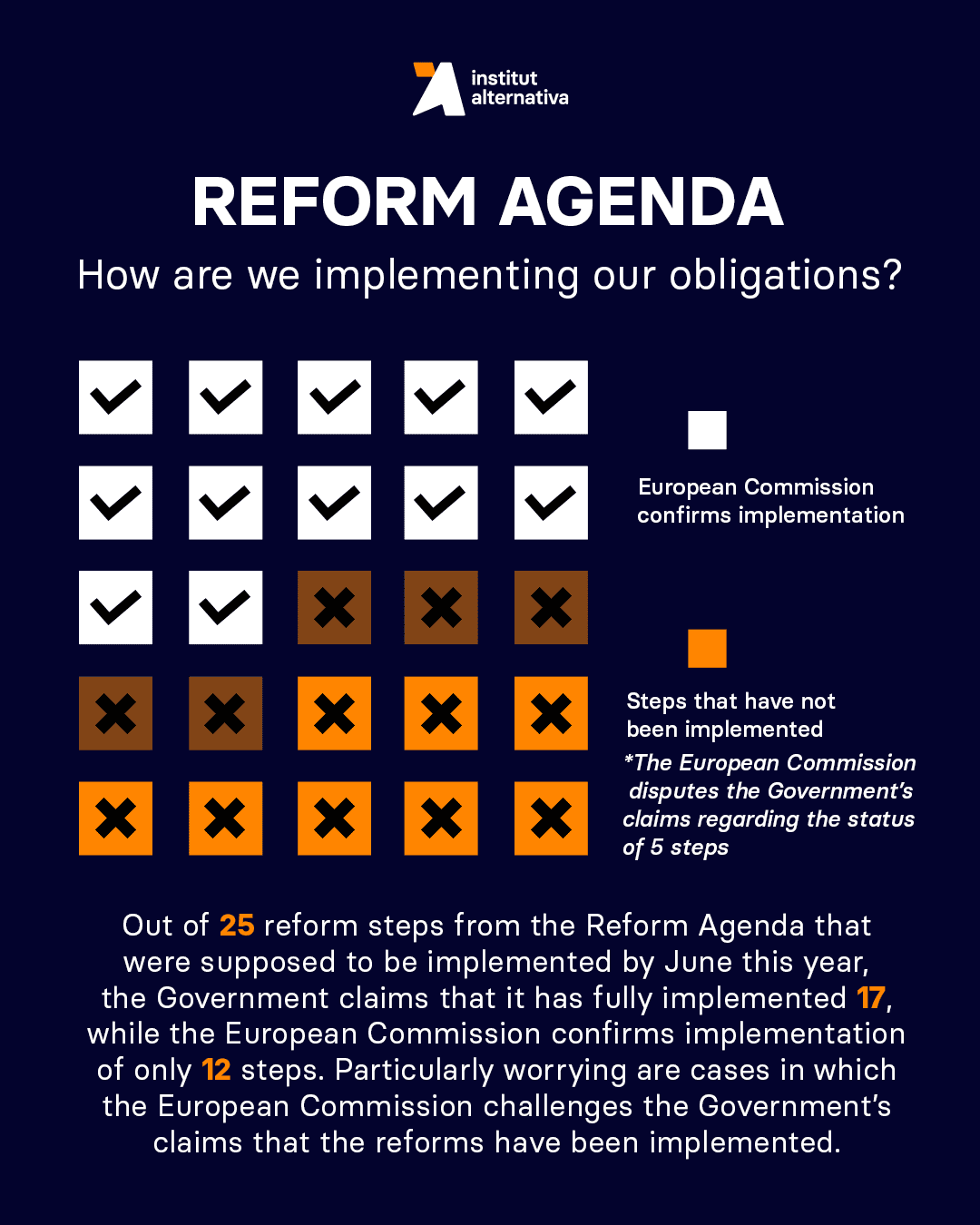
Out of 25 reform steps from the Reform Agenda that were supposed to be implemented by June this year, the Government claims that 17 have been fully implemented, while the European Commission states that only 12 steps have been completed.

This also affects the funds withdrawn – out of the full amount that would have been available had all 25 reform steps been implemented – a total of €52.14 million – €19.70 million gross has been paid, or €18.26 million net after deductions for pre-financing. This represents only about 38% of the available funds.

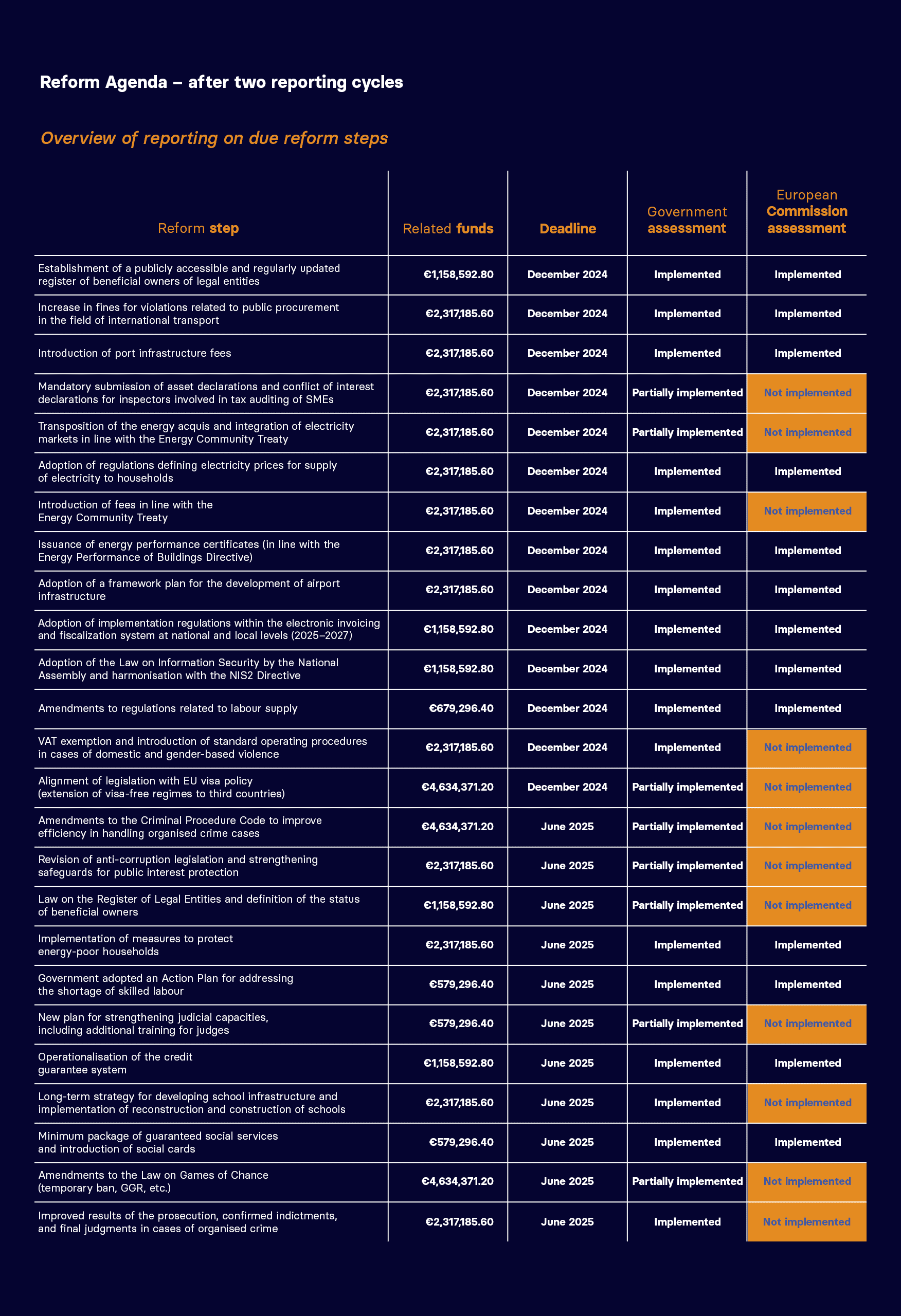
Particularly worrying are cases where the European Commission’s assessment does not align with the Government’s evaluation of the level of reform implementation.A good example of the disagreement between the Government and the European Commission is the reform step related to connecting the Special State Prosecutor’s Office (SSPO) and granting access to the databases of institutions it cooperates with, the completion of which would bring €2.1 million. The Government lists this measure as fully completed, while the European Commission assesses that the measure has not been implemented because three key databases are still not directly accessible to the SSPO: the Tax Administration’s records of issued and received invoices of legal entities; data from the Central Bank on indebtedness, transactions, and account blockages; as well as transaction data available to the Central Bank and historical cadastral data from the Real Estate Administration.

In other words, the Government officially claims that full compliance has been achieved, while the European Commission, through its detailed review, refutes the Government’s claims and, accordingly, only partially approves the disbursement of funds. A similar pattern appears in steps related to energy, digitalization, the rule of law, and corporate governance. In the same way, disagreements have arisen regarding the assessment of the fulfillment of measures for a total of 13 reform steps (out of 25 in total), for which the Government claims full or partial implementation, while the European Commission, through analysis of the submitted evidence and its assessment, concludes that they have not been achieved.The discrepancy comes down to the same rule – the European Commission requires thoroughly proven functionality and maintains the assessment “not achieved,” resulting in partial payments that are significantly below the available amount. These cases precisely explain why only part of the funds from the Growth Plan has been withdrawn so far.

The funds that have not yet been paid are not lost, as there is a one-year “grace period” during which they can still be withdrawn if the reforms are implemented. However, it should be borne in mind that by December of this year an additional 32 steps must be implemented, potentially bringing €83.4 million. Therefore, in addition to the unfinished obligations carried over since December last year (a total of 13 measures), by the end of the year we also have 32 new measures for which we will have to report to the European Commission on what has been done. The accumulation of obligations in the first year of implementing the Reform Agenda testifies to a lack of capacity and insufficient commitment of the competent institutions to implement the reforms they themselves proposed within the defined deadlines.

Marko Sošić

Photo: Gemini

[Video] Reform and Growth Facility: A new chapter for the Western Balkans

Crna Gora- Pregled ispunjenosti Reformske agende: Pilot-monitor reformi

Ovaj Pregled ispunjenosti Reformske agende: Pilot-monitor reformi prvi je u nizu nacionalnih izvještaja o monitoringu u okviru projekta „Monitor reformi”. 

Prvi Pregled ispunjenosti Reformske agende – Pilot-monitor reformi je preliminarno ažuriranje namijenjeno kao opšti presjek stanja (i napomena!) koji se objavljuje sredinom godine, a ne kao detaljna evaluacija. Kako projektni tim probno primenjuje metodološki pristup i indikatore, nove izmjene u narednim sedmicama mogu promijeniti status reformi koje su trenutno na čekanju. 

Monitor reformi prati implementaciju odabranih reformskih koraka iz Reformskih agendi. Odabrani koraci reformi organizovani su u takozvanim „sektorima politike” koji spadaju u oblasti i pod-oblasti politika obuhvaćenih Reformskom agendom. Ovi „sektori politike” su utvrđeni nakon dodatne identifikacije reformi i kodiranja reformskih koraka koje je obavio projektni tim. Ovakav pristup je izabran radi fokusa na reformskim koracima zajedničkim cijelom regionu Zapadnog Balkana, kako bi se omogućile analize na regionalnom nivou, postavljanje istovjetnih mjerila i uporedivost, s obzirom na raspoložive ljudske resurse i tematsku ekspertizu TEN mreže. Za metodološke napomene i proces odabira reformskih koraka, pogledajte napomenu o nacrtu metodologije. 

Ovo probno ažuriranje podataka o ispunjenosti Reformske agende prati strukturu usklađenu sa metodologijom projekta „Monitor reformi“, koja obuhvata: (1) Izvršni sažetak; (2) Proceduralnu usklađenost sa Instrumentom za reforme i rast; (3) Status realizacije reformskih koraka po sektorima politike; i (4) Narativ i analizu ključnih pozitivnih koraka i izazova. Svaki odjeljak daje pregled ostvarenog napretka i prepreka u vezi sa sprovođenjem Reformske agende Crne Gore.

Napomena: Rok za prikupljanje podataka i procjenu u okviru ovog ažuriranja je 30. jun 2025. godine. Događaji koji su uslijedili nakon ovog datuma nijesu obuhvaćeni ovim izvještajem, već će biti razmotreni u narednim ažuriranjima.

RA_Pilot-Reform-Monitor_Montenegro_First-Semester-2025_As-of-June-2025-1

Download

EC approves second release of funds for Albania, Montenegro and North Macedonia under the Western Balkans Growth Plan

On 16 October 2025, the European Commission published the second implementing decision for the release of funds to Albania, Montenegro, and North Macedonia under the Reform and Growth Facility for the Western Balkans, part of the broader Growth Plan.

The Commission’s decisions are based on evaluations of compliance with political preconditions, macro-financial stability, and specific reform commitments outlined in each country’s Reform Agenda. The release follows positive assessments of reform progress and macroeconomic conditions in the three countries, and partial implementation of specific reform steps under the Reform Agendas.

The Commission’s implementing decision approving release of funds to Albania, Montenegro and North Macedonia under the Reform and Growth Facility for the Western Balkans is avaliable here.

Albania

The European Commission found that  21 out of the 41 payment conditions related to the reform steps as set in its request and in its Reform Agenda are fulfilled by Albania. With that, the country will receive its first release of €99,323,541.9 net (post-pre-financing clearance): € 28,504,617.19 in non-repayable grants and € 70,818,924.71 in loans, with 34.75% (€ 24,609,576.34) allocated to the Western Balkans Investment Framework (WBIF). This disbursement comes in recognition of Albania’s progress on key governance and economic reforms, including public administration reform, judicial efficiency, and digitalisation of public services. Specific projects under WBIF will focus on enhancing sustainable transport networks and clean energy initiatives.

The Assessment of the Conditions for Payments is available here.

Montenegro

The European Commission found that  5 out of 18 payment conditions related to the reform steps as set out in its second request for disbursement are fulfilled by Montenegro with a deadline due June 2025. In total, Montenegro fulfilled 12 reform steps so far. With that, the country will receive its second release of funds of € 8,083,884.46 net (post-pre-financing clearance): € 2,319,973.97 in non-repayable grants and € 5,763,910.49 in loans, with 34.75% (€ 2,002,958.90) allocated to the Western Balkans Investment Framework (WBIF). 

This release follows the country’s successful implementation of reforms in public sector transparency, digital transition, and energy efficiency. Notably, Montenegro has improved the accessibility of data on State-Owned Enterprises (SOEs) and adopted several key laws aligned with EU directives, such as the Law on Information Security in line with the NIS2 directive. 

The Assessment of the Conditions for Payments is available here.

North Macedonia

The European Commission found that  4 of of 16 payment conditions with a deadline due June 2025 are fulfilled by North Macedonia, or in total 6 out of 21 for both semesters. With that, the country will receive its second disbursement of  €15,929,721.7 net (post-pre-financing clearance): € 4,571,631.37  in non-repayable grants and € 11,358,090.36 in loans, with 34.75% (€ 3,946,936.40 ) allocated to the Western Balkans Investment Framework (WBIF). The country demonstrated progress in corporate governance, internal financial controls, and justice sector reforms, although key challenges remain, particularly in the fight against high-level corruption and political interference in the judiciary.

The Assessment of the Conditions for Payments is available here.

Next Steps

The facility rewards the beneficiaries who demonstrate measurable progress in implementing their Reform Agendas in areas like the rule of law, governance, green and digital transitions, and public financial management.

Assessments for Serbia are not yet published, and the country has not yet received funding under the RGF apart from the prefinancing that beneficiaries received. In contrast, Kosovo has not yet ratified the necessary agreements, and Bosnia and Herzegovina is awaiting the Commission’s approval of its Reform Agenda.

You can find further documents and implementing decisions in the Documents section of our website.